


 106 / 114

[
] 104
Political leaders and the Government encouraged women’s
political participation with the goal of promoting the presence
of women in parliament. The law on election of members of
the Advisory Council (Royal Decree 58/2013) states the terms
of election to the council in conformity with the provisions of
the Statute of the State, so that women have the right to stand
and vote in parliament.
Omani women were first appointed to the Gulf Cooperation
Council Shura in 1994, in an experiment that began in
Muscat. Many efforts have been made to qualify candidates
for the Shura Council and to implement training programmes
in the electoral process and campaign management for female
candidates of the seventh and eighth sessions of the council.
A training guide was issued to male and female candidates for
board membership. The Interior Ministry organized seminars,
called Consultative Forums, in all provinces of the Sultanate.
These forums aimed to guide voters on the importance of the
role of Shura Council members and the importance of elec-
toral participation. They were broadcast on Omani television.
Omani women currently occupy ministerial positions in the
Ministry of Higher Education and the Ministry of Education,
and a woman holds the rank of Minister of the Public Authority
for Craft Industries. Two women also occupy deputy secretary
positions, in the Ministry of Manpower for technical education
and training, and as undersecretary of the Ministry of Tourism.
Women represented 17 per cent of the Council of State
during the seventh period (2015-2019). One woman member
was elected as vice-president for the first time since the crea-
tion of the council. Women represented 1.2 per cent of
participants in the Shura Council in the 2015-2019 term. Four
women ran as ambassador, and 3 per cent of participants in
municipal councils were women in the 2012-2016 term.
The proportion of women employed in auxiliary func-
tions was 19 per cent (head of claim, first and second under a
general allegation, and associate) in 2015.
Eleven per cent of Omani lawyers were women in 2014.
Women currently occupy 22 per cent of supervisory and lead-
ership positions such as consultant, expert, assistant general
manager or director. In addition, 11 per cent of diplomatic
service roles are taken by women.
Women’s participation in public life has also developed.
Omani Women’s Associations are considered social institutions
with a deep and active history in the social life of Omani society.
They attract a considerable number of members, who dramati-
cally contribute to the development of their local society through
voluntary work and planned events. The number of Omani
Women Associations had grown to 60 by the end of 2015.
Charitable associations and institutions provide an oppor-
tunity for women to participate in charitable efforts and social
programmes for the benefit of society. At the end of 2015 there
were 28 charitable associations and institutions in Oman.
Occupational associations aim to promote awareness and
professional linkages for their members. There were 28 of
these associations at the end of 2015.
Community clubs are voluntary social institutions aiming to
strengthen the bonds of friendship and love between members
of the same community. The number of these clubs reached
15 by the end of 2015.
Omani women’s participation in the economic field is
regarded as an important role in society. The Omani market
has seen an increasing contribution from Omani women in
the economic field in recent years.
At the legislative level, Royal Decree 55/1990 was issued as
the Trade Law, in which Article 21 states that anyone reaching
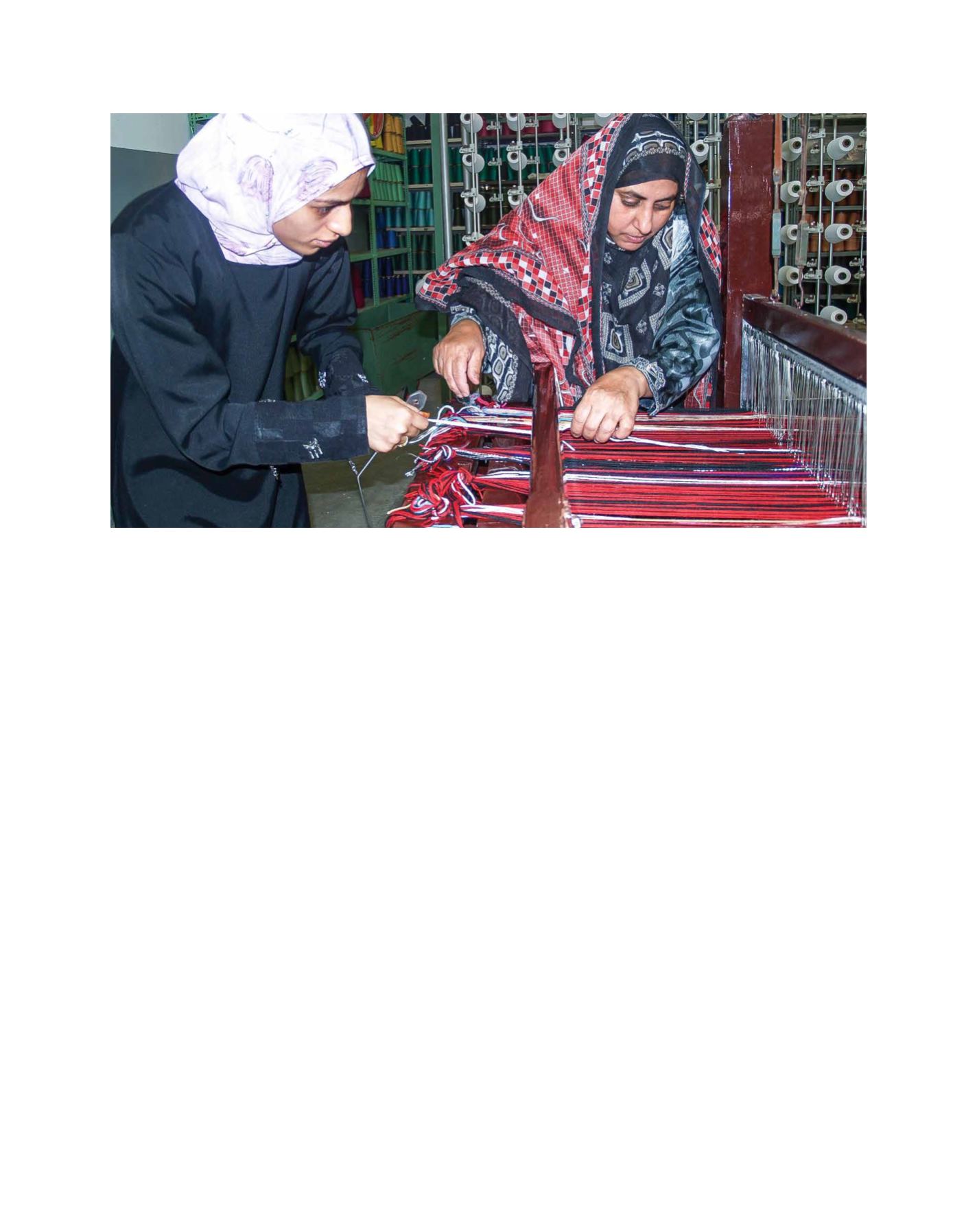
Image: Ministry of Social Development, Oman
Women play a key role in preserving the country’s heritage
A B
etter
W
orld