


 62 / 74

[
] 60
A B
et ter
W
or ld
mar our region and the rest of the world. Our recent publi-
cation
Contemporary Slavery As Instituted by Terrorist Groups
in Iraq and Syria
challenges all of its readers. It exposes not
only the use of slavery as a recruitment tool by ISIS, but also
the ambient socio-religious factors that made a resurgence of
slavery possible on Arab soil. We looked beyond our region
to learn about the scourge of slavery the world over, as well as
the means by which abolitionists in many countries managed
to overcome it. This volume, like so many others, sought
not only to expose a challenging problem but also to lay the
groundwork for its solution.
Publishing books about these topics was not always
easy, as some are controversial in our region. But we did
not allow objections from retrograde elements to prevent us
from pursuing our passions. Our resolve to persevere was
continually strengthened by our host country, the United
Arab Emirates – both its leadership and its people – perhaps
the greatest bastion of tolerance in the Arab world today. And
in addition to distributing the books locally and among our
paid subscribers, we have taken them to book fairs all over
the Middle East. We have translated some into English and
other languages. In approaching future volumes, we continu-
ally seek out new scholarly voices, far beyond the core group
of researchers who have been with us since the beginning.
As a natural outgrowth of our publication of books and
papers, Al-Mesbar Center saw fit to convene conferences
and workshops, first in our offices and subsequently with
partnering institutions in Europe and the United States. The
number of public events has grown into the dozens. Among
the sessions of which I am proudest is one we convened in
our offices in Dubai last year. We hosted Behar, a Yazidi
woman who was abducted and abused by ISIS. In telling her
harrowing story, she not only evoked the tears and compas-
sion of our community; she also challenged us to confront
the legacy of sectarian chauvinism in our region which did
not begin with ISIS – and ask, all over again, what we can
do to combat it.
One of the reasons why these initiatives have courted
controversy is that they have echoed far beyond the walls of
Al-Mesbar. Through our network of friends and supporters,
the books and workshops are often covered, excerpted, or
debated in some of the most popular broadcasts and publi-
cations in the Arabic language. When we achieve this level
of attention, at times reaching tens of millions, we feel that
we are succeeding in one of our core missions, as mentioned
earlier – to migrate the values of tolerance from intellectual
elites to people of all walks of life and every level of literacy.
Extremists want to keep reformist intellectuals isolated from
the broader society. We must not let them succeed.
On numerous occasions I have been heartened and humbled
to receive an award for my role at Al-Mesbar Center, not just in
the Arab world but also in the West. In travelling overseas for
these special events, whether to Europe or the United States, I
am sadly reminded that the problems of intolerance and extrem-
ism are not limited to a single part of the world. I am sometimes
confronted by hostility toward the society into which I was
born – a feeling in some Western quarters that all Gulf Arabs,
or all Muslims, are extremists. So when I receive an award, I try
to use it as an opportunity to creatively address these misper-
ceptions, by bringing the Al-Mesbar message to a new audience.
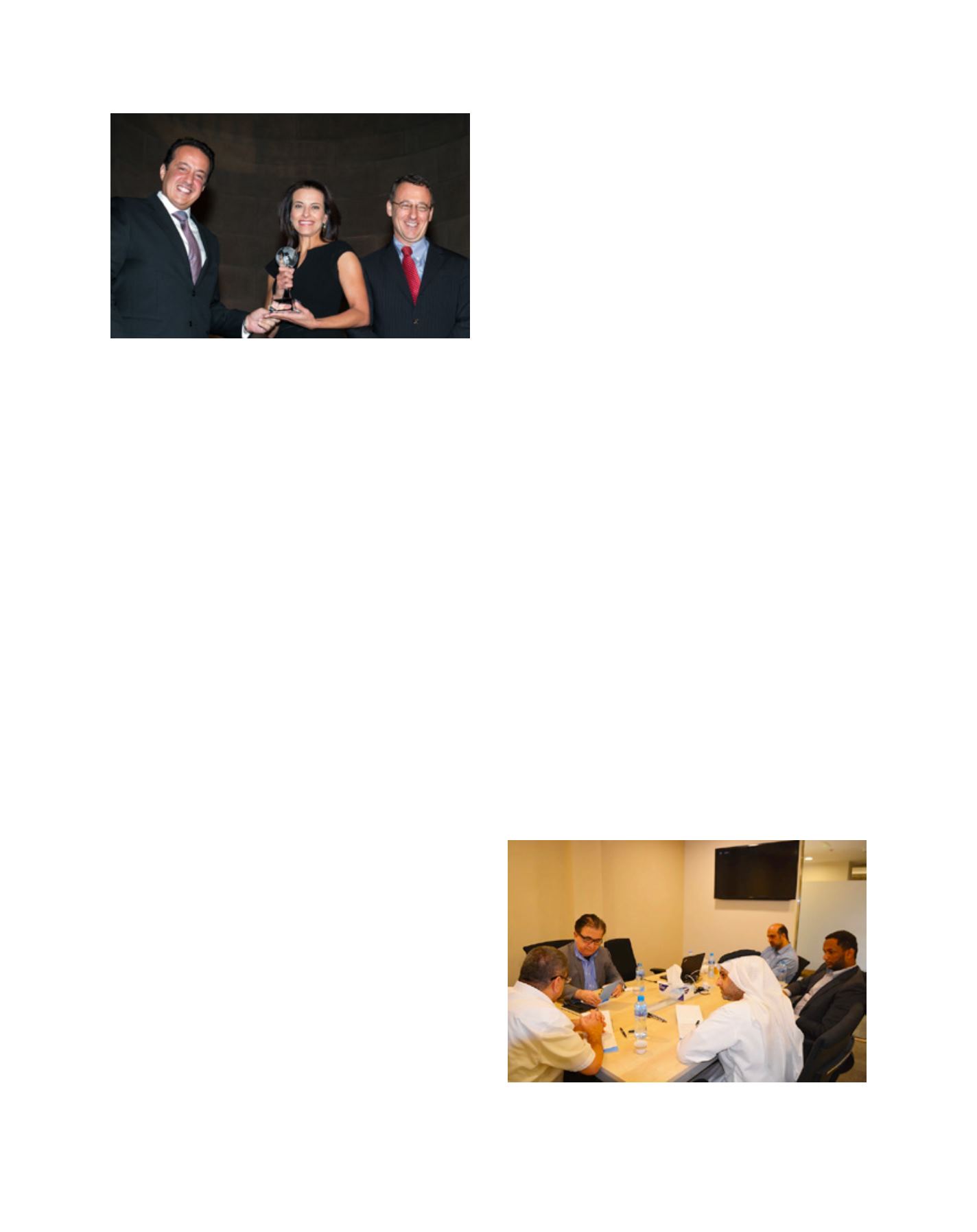
A case in point: In November 2014, I had the honour of accept-
ing a lifetime achievement award from America Abroad Media,
a Washington institution devoted to promoting international
understanding through public communications. When I came
to the gala event, I brought along some friends: the 30-member
Antakya Choir from Turkey, which had been nominated for
the Nobel Peace Prize only a few years earlier. Composed of
TurkishMuslims, Christians, and Jews and embodying the best
values of their native land, they performed searing music and
lyrics from their respective faith traditions. In an especially
poignant moment, they dedicated a Christian song of God to
families of the victims of the September 11 tragedy who were in
the audience. I will never forget the experience of sharing tears,
sadness, and love with my brothers and sisters in humanity that
night. No song can soothe the pain they will forever feel, but
in our music, our language, our prayers, and our ideals, we can
conjure a world in which these tragedies do not happen again.
Through our hard work each day, we can begin to realize that
vision. It is an unending task. We are but a ship in a mighty
sea. Yet even in the dead of night, we see a house of light in the
distance, we set our course, and we move ahead.
Al-Mesbar Chairman, Mr. Turki Al-Dakhil receiving an award from American
Abroad Media for his lifetime dedication to advancing women and minority
rights in the Middle East. He is awarded by Dina Powell, currently US Deputy
National Security Advisor for Strategy, and Aaron Lobel, founder of American
Abroad Media
The Al-Mesbar team met with Mr. Abe Radkin of UNESCO’s Project Alladin
to discuss potential cooperation in the fields of tolerance, coexistence and
peace that align with UNESCO’s Decade for Cultural Rapprochement
Image: Al Mesbar
Image: Al Mesbar