



 57 / 74

[
] 55
J
ust
, P
e aceful
and
I
nclusi v e
S
ocieties
organizational capacity, skills and accountability required
to engage with key stakeholders. It is essential that local
and national NGOs have this pathway for graduation where
they can meet donors’ due diligence requirements, and
access funding directly without any intermediaries. No such
pathway for graduation and eventual independence exists in
both the humanitarian and development systems.
Other than organizational development and financing, the
network plans to enhance collaboration between local and
national organizations through advocacy, networking and
communication. Opportunities for south-to-south learning
and networking need to be created without a northern inter-
mediary. It is important to NEAR for such a space to exist, one
where members can find solidarity, fellowship, a platform that
provides opportunities for knowledge sharing and learning
from peer organizations in the global south who understand
and can relate intimately to the challenges they all share.
Meeting the needs of millions of people affected by the
failure of institutions is at the core of the 2030 Agenda for
Sustainable Development, and it resounds with the philoso-
phy of NEAR. All frameworks towards a sustainable future
need to recognize vulnerable individuals not just as recipi-
ents of aid or beneficiaries, but also as people who must be
included in decisions that affect their lives. They are capable
of leading response with their own ideas, values, abilities,
desires and needs.
Finally, while the network is clear on its demands and how
the future of the system must look, it also acknowledges the
challenges ahead. Time, a willingness to abandon old ways
of doing things, and a willingness to fail are all required.
However, with dignified partnerships between international
actors, communities, civil societies, local governments,
national governments, and donors, a realistic way forward
can, and should, be negotiated.
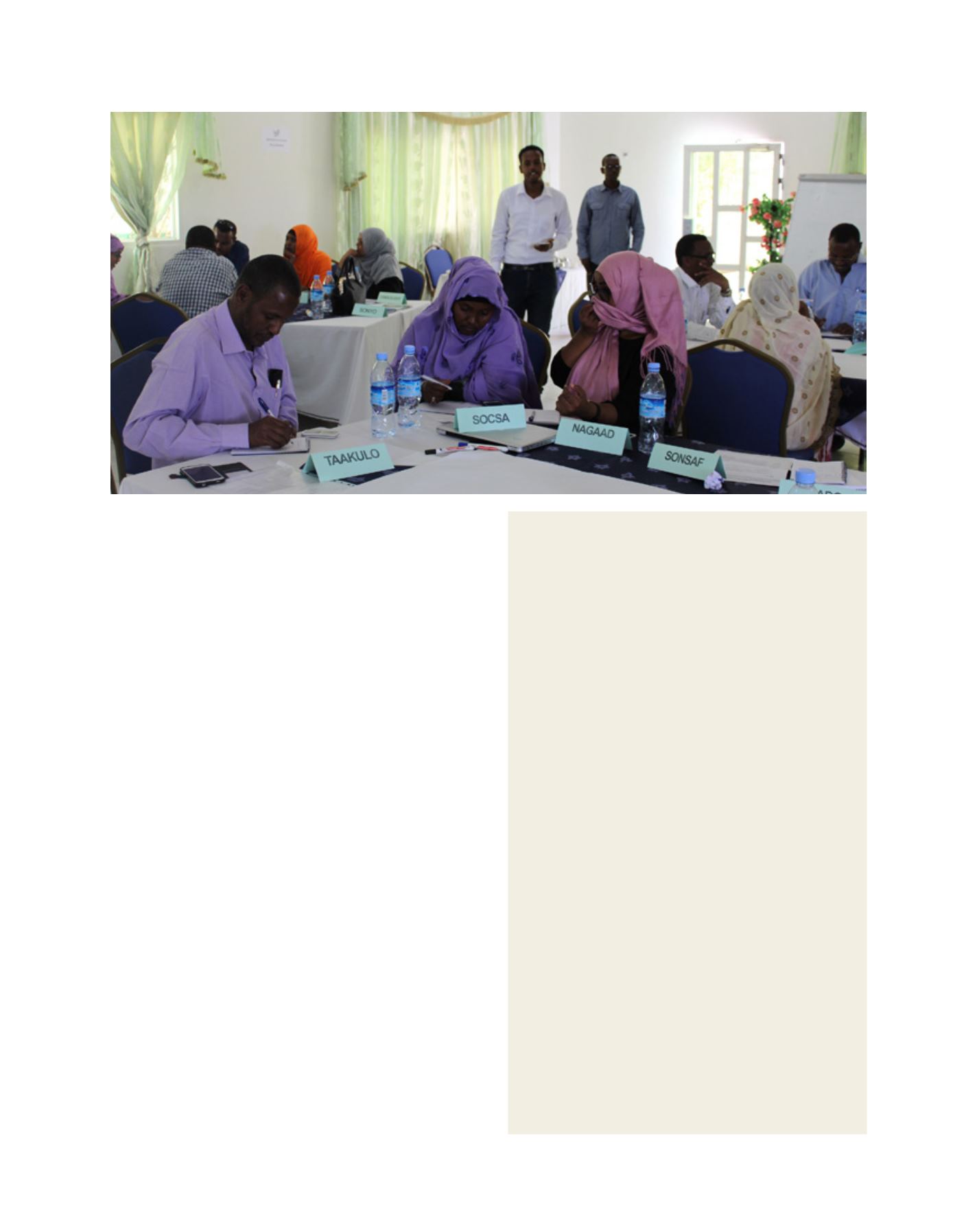
Members of local and national NGOs during a consultation meeting,
Hargeisa, Somaliland
Making a difference in times of local crisis
Between 2014-2016, Ebola devastated thousands of lives in
Liberia. As the country plunged into a health crisis, many other
services, including schools, were crippled. To ensure her children
continued with their education, Brenda Moore of Kids Educations
Engagement Project (KEEP) started home schooling her two
children. She then saw a need in the community and decided to
tutor other schoolchildren in her neighborhood in Monrovia.
“I would print free worksheets and coloring pages per grade
level and place them in a plastic folder with crayons, pencils
sharpeners, and then distribute them free of charge,” says Brenda,
whose organization is now a member of NEAR Network. Every
week, accompanied by a team of volunteers, they would visit the
children in their homes to check on progress. If the homework had
been completed, the team would provide a new set of worksheets.
Brenda and her team of volunteers reached 19 communities and
impacted around 3,000 children without any support from the local
government or international organizations.
Like many other local and national organizations working in
Liberia during the Ebola epidemic, KEEP had challenges in securing
support from donors and international NGOs, who frequently
cited short operation time and lack of track record or capacity as
their reasons for not offering support. The organization eventually
secured support from Action Aid Liberia, consequently extending
their education program to the 52 communities. Through this
partnership, they reached about 6,000 children.
Even with this support, there was still a gap needing to be filled
in administering aid – the involvement of local actors. As Brenda
states: “Local actors serve as first responders. They are also keenly
aware of the cultural setting. They know the geographical settings
and terrain. Because local actors are usually locals themselves,
they inspire the trust of the affected people.” She believes the
international humanitarian system is bureaucratic and sometimes
slow in responding to situations. Additionally, the nature of policies
sometimes restricts the ability for larger organizations to move and
respond speedily in crisis and disaster situations.
“They have a lot of resources available but sometimes they are
brought in too late to help and make meaningful impact.”
Brenda hopes NEAR will form a database to help local
organizations through capacity building, networking, experience
sharing, and directly linking them to funding, enabling them to work
more effectively.