


 53 / 74

[
] 51
J
ust
, P
e aceful
and
I
nclusi v e
S
ocieties
Hope for justice – the readiness of Sri Lanka to
uphold the rule of law
Aruna Muthulingam and M S Dimuthu Kumari, Lecturers, Department of Public Administration,
University of Sri Jayewardenepura, Sri Lanka
S
ri Lanka is renowned as the pearl of the Indian
Ocean, with a sustained history of justice over centu-
ries. However, recent incidents of ethnic conflicts
have tarnished the country’s reputation and branded it
the tear drop in the Indian Ocean. However, these dark
clouds have passed. The initiations of the present national
unity government including the restoration of the constitu-
tional council, the creation of an independent human rights
commission, ratification of the convention for the protec-
tion of all persons from enforced disappearance, and a new
act of right to information are milestones that offer hopes of
justice. People have begun to enjoy the fruits of democracy.
The Keppapulavu land issue has indicated that the people
are able to fight for their rights. People have demanded the
return of land occupied by the armed forces and the govern-
ment has resolved the issue by assuring release of the land.
The present government has promised to ensure justice for
all. Today, the Rule of Law, previously a technical term,
becomes the layman’s buzzword.
The rule of law asserts that countries are governed by law, not
by rulers. Everybody, including the lawmakers themselves,
are therefore subject to the law. No politician, government
official or institution is free to exercise arbitrary power. In a
broader sense, the rule of law implies the absence of injustice,
non-discrimination, respect for human rights, transparency,
accountability, fair trials, the independence of the judiciary,
and equality before the law. All of these areas play significant
roles in achieving a more efficient economy and enabling a
happy and contented life for the people.
It is generally acknowledged in academic literature that
sustainable development and justice – or in broader terms
the rule of law – are hand in glove. The United Nations
Development Programme (UNDP) declares sustainable devel-
opment to be a universal hope to end poverty, protect the
planet and ensure peace and prosperity for all. Sustainable
development means not only material, but economic, social
and environmental growth.
Effective enforcement of the rule of law helps to sustain
development in all aspects. Economic development can be
enhanced by reducing corruption, ensuring property rights,
and building investors’ trust in the legal system. Social devel-
opment can also be enhanced through broadening access to
justice and empowering marginalized groups to fight against
injustice. Also, it improves the lives of ordinary people
and upholds their rights, allowing them to live in dignity.
Environmental development can be enhanced with a legal
system that is concerned with environmental deprivation.
Therefore, the rule of law is an important cornerstone of
sustainable development. The inclusion of ‘Peace, Justice and
Strong Institutions’ as a new goal for the post-2015 develop-
ment agenda is timely. It urges all governments to value the
rule of law in achieving their development goals.
The government of Sri Lanka, elected to power in 2015,
presented a mandate to inculcate good governance practices
and rule of law. The public has waited for almost two years
to realize the results of the new government’s initiatives, but
its gradual slip in the Rule of Law Index – published by the
World Justice Project (WJP) – invites Sri Lanka to rethink its
readiness to protect justice. Sri Lanka’s score had been drop-
ping since 2012 and was ranked 68th among 113 nations in
2016. However, the country has managed to retain its rank
in third place among other South Asian countries.
The Rule of Law Index is a valuable annual review which
gives a comprehensive picture of the extent to which coun-
tries adhere to the rule of law in practice. The index has
been designed based on eight factors, including absence of
corruption; order and security; fundamental rights; open
government; regulatory enforcement; civil justice; and crimi-
nal justice. The index is the reflection of the perceptions of
citizens and experts in each country.
Sri Lanka’s highest score – 0.68 for order and security –
implies that the nation assures the security of persons and
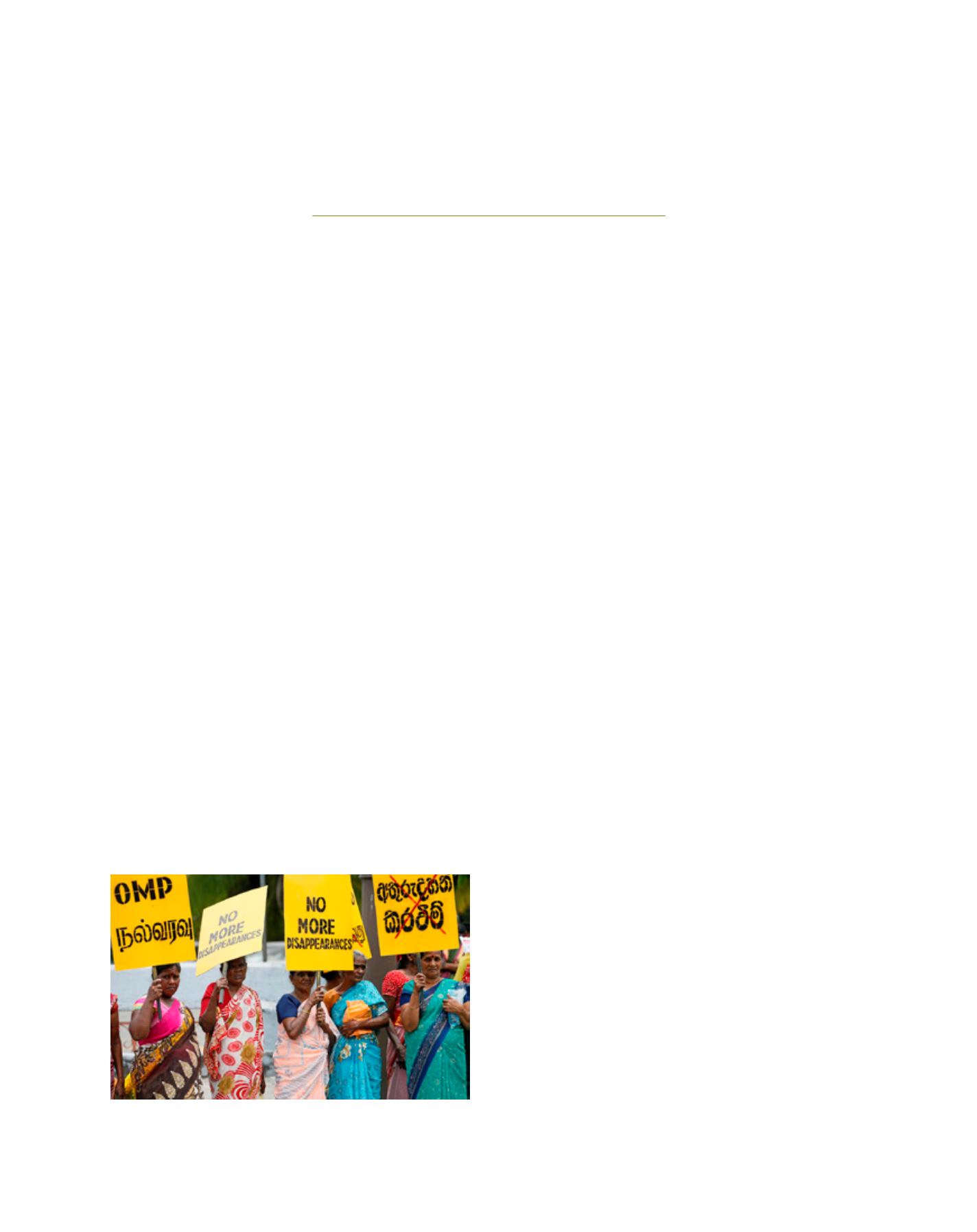
Women conduct a silent protest to commemorate the International Day of the
Victims of Enforced Disappearances in Colombo, 30 August 2016
Image: © 2016 Dinuka Liyanawatte/Reuters