



 51 / 74

[
] 49
J
ust
, P
e aceful
and
I
nclusi v e
S
ocieties
Growth of these sectors coupled with increasing population
pressure has been associated with a degraded agro-ecosystem
including rivers, wetlands, and coastal and urban environ-
ments as well as the degradation and depletion of ground
water, deforestation and desertification, affecting livelihoods
and quality of life. The other challenge to sustainability stems
from climate-induced changes caused by greenhouse gases in
the atmosphere which is growing at an unprecedented rate and
magnitude. The manifestation of climate change is very much
evident in Bangladesh. The coastal region in the South and
SouthWestern part of Bangladesh is already faced with frequent
high tide episodes, induced inundation and salinity intrusion,
reduced livelihood opportunities and so on. More frequent and
severe floods, tropical cyclones, storm surges and droughts pose
multiple threats to growth and the achievement of Vision 2021
targets. There is also a regional challenge to sustainability –
a decline in water flow in trans-boundary rivers has resulted
in siltation, with desertification in the north west and salinity
intrusion in the south west areas of the country with conse-
quent adverse effects on the environment and livelihoods.
Sustainable development is thus a constitutional obliga-
tion in Bangladesh. The state shall endeavour to protect and
improve the environment and to preserve and safeguard
natural resources, biodiversity, wetlands, forests and wild-
life for the present and future citizens. Bangladesh began
preparing the national sustainable development strategy in
2009. Later, it was decided to revise and update the NSDS in
light of the Sixth Five Year Plan (SFYP), the Perspective Plan
(2010–2021), and other recent plans, policies and strategies
formulated by the government. In pursuant of the outline
agreed in the Rio+20 declarations, the NSDS (2010–2021)
was finalized in 2013. The principle of sustainable devel-
opment is living within environmental limits, achieving a
sustainable economy, promoting good governance, using
sound science responsibility, ensuring a strong, healthy and
just society. Bangladesh has one of the most fertile lands, and
so agriculture is the main livelihood. The country has a rich
water system and biodiversity which includes rivers, canals,
ponds and wetlands. Having many natural resources like oil
and gas both onshore and offshore, and coal in the north of
the country, there is also an industrious and creative work
force but it is trapped in cycle of poverty and vulnerability.
Bangladesh is one of the largest deltas in the world which
is highly vulnerable to natural disasters because of its
geographical location, its flat and low-lying landscape, popu-
lation density, poverty, illiteracy, and lack of institutional
infrastructure. In other words, the country’s physical, social
and economic conditions are typical of any of the countries
most vulnerable to natural disaster in the world.
So, Bangladesh is a country of potential and of poverty. The
population is more than 160 million with a density of more
than 1,300 per sq. km. The 147,570 sq. km. land area consists
mostly of flood plains (almost 80 per cent) leaving a major
part of the country – with the exception of the north-west-
ern highlands – prone to flooding during the rainy season.
Moreover, the adverse affects of climate change – especially
high temperatures, rising sea-levels, cyclones and storm
surges, salinity intrusion, and heavy monsoon downpours –
has aggravated the overall economic development to a great
extent. Life expectancy in Bangladesh is around 63 years,
and the adult literacy rate is 47.5 per cent. The recent Human
Development Report ranks Bangladesh number 140 of 177
nations. The country has an average annual population
growth rate of around 2 per cent (4.6 per cent in urban areas),
almost 75 per cent of the population lives in rural areas with
two thirds of those engaged mainly in farming or agro-based
industrial activity. Bangladesh is one of developing countries
of south-east Asia but is visited by natural calamities almost
every year, rendering a life of great challenge.
The environmental problems are partly a consequence of
the country’s development activities and largely a conse-
quence of global production and consumption activities.
Bangladesh will need to make appropriate responses to
degradation in a number of areas such as water resources,
forest and biodiversity, land and soil, coastal and marine
resources and natural disasters and climate change. The
priority sectors which are important to sustainable develop-
ment are agriculture, industry, energy, transport and human
resource development. The strategies suggested under these
sectors will remain the engine for overall economic growth
and will support further development.
Bangladesh needs to balance the economic, social and
environmental requirements of development in order to
ensure that “the needs of the present generation are met
without compromising the ability of the future generations
to meet their own needs.” Despite past achievements, a large
population is still in poverty and the unemployment and
underemployment rates are still high. The achievement of
high growth so urgent that it is easy to downplay the right
of the next generation to natural resources. But a large and
growing population living in a relatively small geographi-
cal area which is increasingly pressurizing our environment
– air, water and soil – dictates the urgency of sustainable
development in the country. NSDS fulfils the twin objectives
of formulating strategies to meet the challenges of economic,
social and environmental sustainability faced by the economy
as well as meeting international obligation of the country to
global sustainable development principles and agenda.
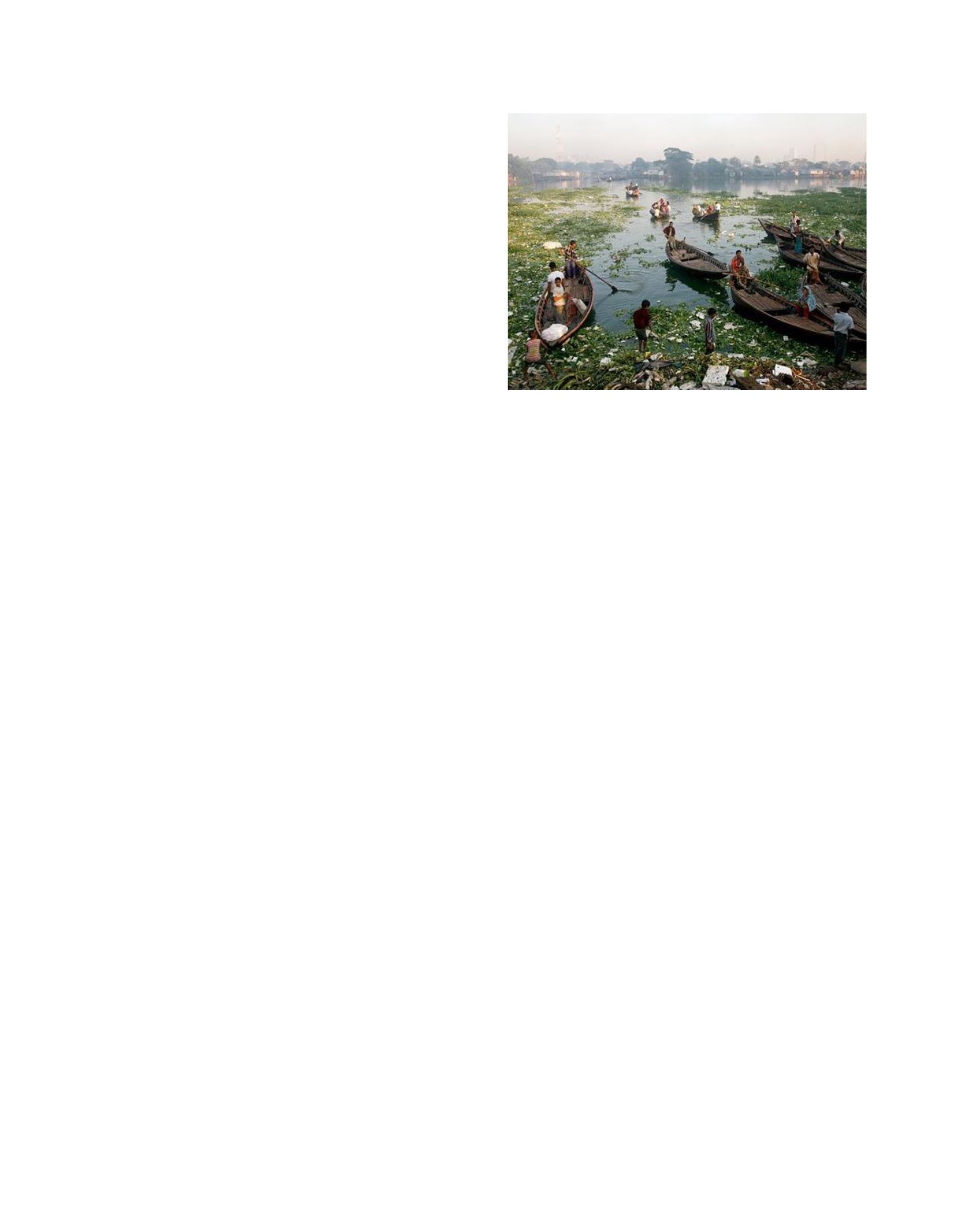
Man-made environmental degradation in the capital city Dhaka, Bangladesh.
The polluted water is a serious health hazard
Touhid Alam, PRC. bd