



 48 / 74

[
] 46
A B
et ter
W
or ld
comes to an end. And yet, when people own a social problem
and feel compelled to solve it, the possibility of developing
lasting solutions increases manifold.
Inequality is now a major global concern that is threat-
ening the peace and social justice. According to the Global
Wealth Databook 2016, the richest 1% of the population
holds more wealth than the rest of the world combined, while
the recently published Oxfam report, An Economy for the
99%, states that “only eight men own the same amount of
wealth as the poorest half of the world.”
Inclusive society, a society in which everyone has an active
role to play and has the opportunity to reach their maximum
potential, is one effective way of addressing rising inequality.
This is also an important prerequisite for sustainable develop-
ment. An inclusive society benefits not only the marginalized
and poor but everyone, as we can see that social exclusion
breeds crime, conflict and social instability. Moreover, when
certain groups or classes feel excluded and marginalized
from the rest of society, they are more likely to lose intrinsic
values like kindness, empathy and togetherness.
Indeed, by integrating everyone, inclusive society promotes
social values and develops institutions that create platforms
for people to participate in political, social, economic,
cultural and civic activities. Participation also plays a major
role in building mutual trust, which shapes how social
responsibilities will be shared. Such society embraces every-
one, regardless of their race, caste, ethnicity and gender. In
this instance, diversity is considered as a strength, not a
ground for discrimination.
It is important that people are given proper motivation
to participate, and this participation should be across all
phases. Additionally, people should have easy access to
public information so that they are connected by common
understanding. Media has a significant role to play in bridg-
ing the information gap between different groups and classes.
Similarly, digital divides also need to be addressed. As Eric
Schmidt Jared Cohen (2013) warned, a “digital caste system”
may emerge since people’s experience with technology will
be greatly determined by where they fall in the structure and
the connectivity experience will not be uniform as there will
be technological elite and proletariat, privileged and margin-
alized.
Positive engagements encourage people to think critically
and act rationally, and thus develop a sense of responsible
citizenship at both local and national level. Importantly,
social inclusion is a cross-sectional and multi-dimensional
concept, which should be mainstream across all different
areas and levels.
Take the example of the Village Level Child Protection
Committee (VLCPC), a community-based child protection
unit formed by Village Panchayat (village council) in differ-
ent states of India for the protection of children’s rights. Each
committee includes two children representatives, which are
led by the Panchayat President. In some villages, Junior
Panchayat – the village’s child representatives – hold meet-
ings with the Senior Panchayat once a month to discuss the
issues concerning children’s rights. VLCPCs are now actively
participating in community governance, and addressing
social issues like prevention of child marriage. The impact is
noteworthy: National Family Health Survey (NFHS) IV find-
ings show that child marriage in West Bengal, for example,
has declined from 53% to 40%.
Citizen engagement should be considered the backbone
of good governance. Corruption and lack of transparency
are evident when the public has limited involvement in the
process.
Over the last few decades, many countries, especially in
Asia, have made impressive progress in reducing poverty
and improving other key development indicators. To sustain
momentum, the greatest challenge for these emerging coun-
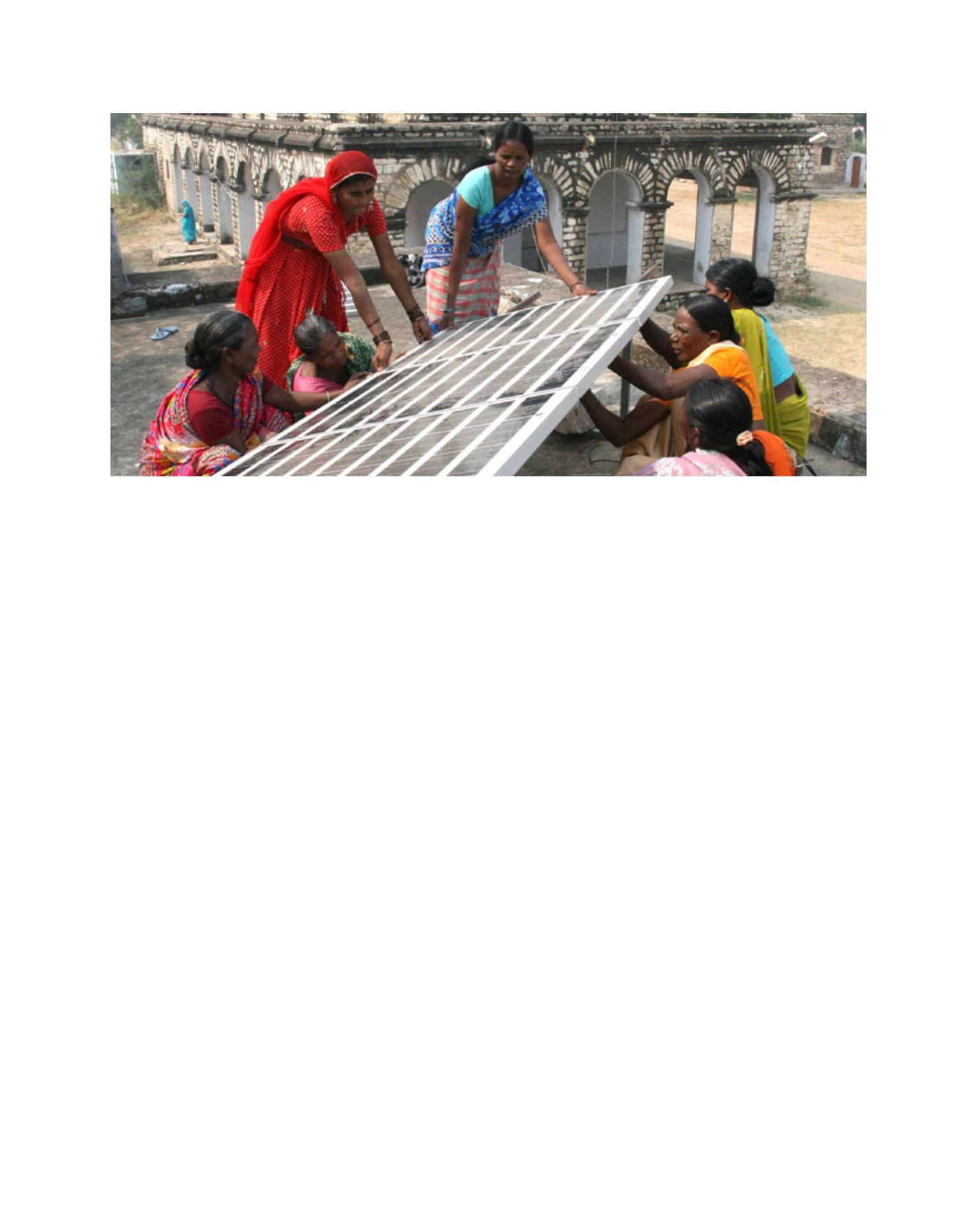
Semi-literate rural women turned solar engineers installing solar panels, Rajsthan, India
Image: Barefoot College