



 43 / 74

[
] 41
J
ust
, P
e aceful
and
I
nclusi v e
S
ocieties
provision of goods and services related to mitigation and
adaptation. Such green
awqaf
may be established as dedi-
cated entities for the conservation of soil, water, plants, and
waste disposal.
Awqaf
may also be dedicated to research and
development that induce a movement along the learning
curve and fall in clean technology prices.
Awqaf
may be dedi-
cated towards increasing consumer awareness and a stronger
support of action to mitigate climate change.
Zakat
is also increasingly being seen as a tool of humani-
tarian finance. An interesting 2015 document:
An Act of Faith:
Humanitarian Financing and Zakat
, echoes the concerns
expressed by the UN Humanitarian Summit at the ever-
increasing demand and supply gap for humanitarian funds
and suggests mainstreaming of the
zakat
sector to meet the
resource gap.
The primary issue with a philanthropy-based solution
to multiple development challenges is one of sustainabil-
ity. Funds mobilized through donation-based tools tend to
fluctuate from time to time and may not lend themselves
to careful planning and implementation. Conceptually, this
is not true in case of
zakat
, which is a compulsory annual
levy on eligible Muslims. Therefore,
zakat
should result
in regular and recurring cash flows. Benefits from
waqf
or
endowed assets are meant to flow, also on a sustainable
basis. Empirical evidence from the IRTI reports corrobo-
rate this possibility. Most of the countries where the Islamic
social finance sector has witnessed proactive and progres-
sive regulation and other enabling measures, e.g. Malaysia,
Indonesia, Saudi Arabia and Sudan, are also characterized
by exponential growth in the flow of Islamic social funds
over time. Case studies of successful Islamic social finance
institutions at a micro level have demonstrated that
zakat
is sustainable, dependable and could be a growing source
of funds for institutions that acquire the necessary profes-
sionalism in fund-raising and seek continued betterment in
their social credibility through integrity, transparency and
good governance. Endowments (
awqaf
) – physical as well as
cash – have successfully been developed with the infusion of
private capital in an enabling regulatory, fiscal and progres-
sive Shariah environment such as, in Singapore, Malaysia
and Sudan, resulting in a steady enhancement of benefits
to the intended beneficiaries. Success stories of
qard
-based
financing of the poor, such as in Pakistan and Iran, have also
been well-documented.
Islamic social funds, especially
zakah
and
awqaf
, can
potentially meet resource shortfalls to alleviate widespread
poverty. Recent studies by IRTI as well as by the World Bank
have estimated the potential
zakat
collection in their member
countries and concluded that such funds by themselves can
meet the entire resources shortfall to lift every single poor
out of extreme poverty. However, the potential remains unre-
alized as actual
zakah
mobilized and returns of
awqaf
assets
fall far short of their potential in most countries.
Despite overarching goals of social justice and equity,
Islamic banking,
takaful
and the Islamic capital market
are for-profit sectors that have been criticized for not doing
enough to help the poor and unbankable. Islamic social
finance has a significant role to play in alleviating poverty. A
sustained flow of social funds demands high degrees of social
acceptance and credibility, which in turn, are influenced by
levels of integrity, transparency and professionalism in the
management of these funds.
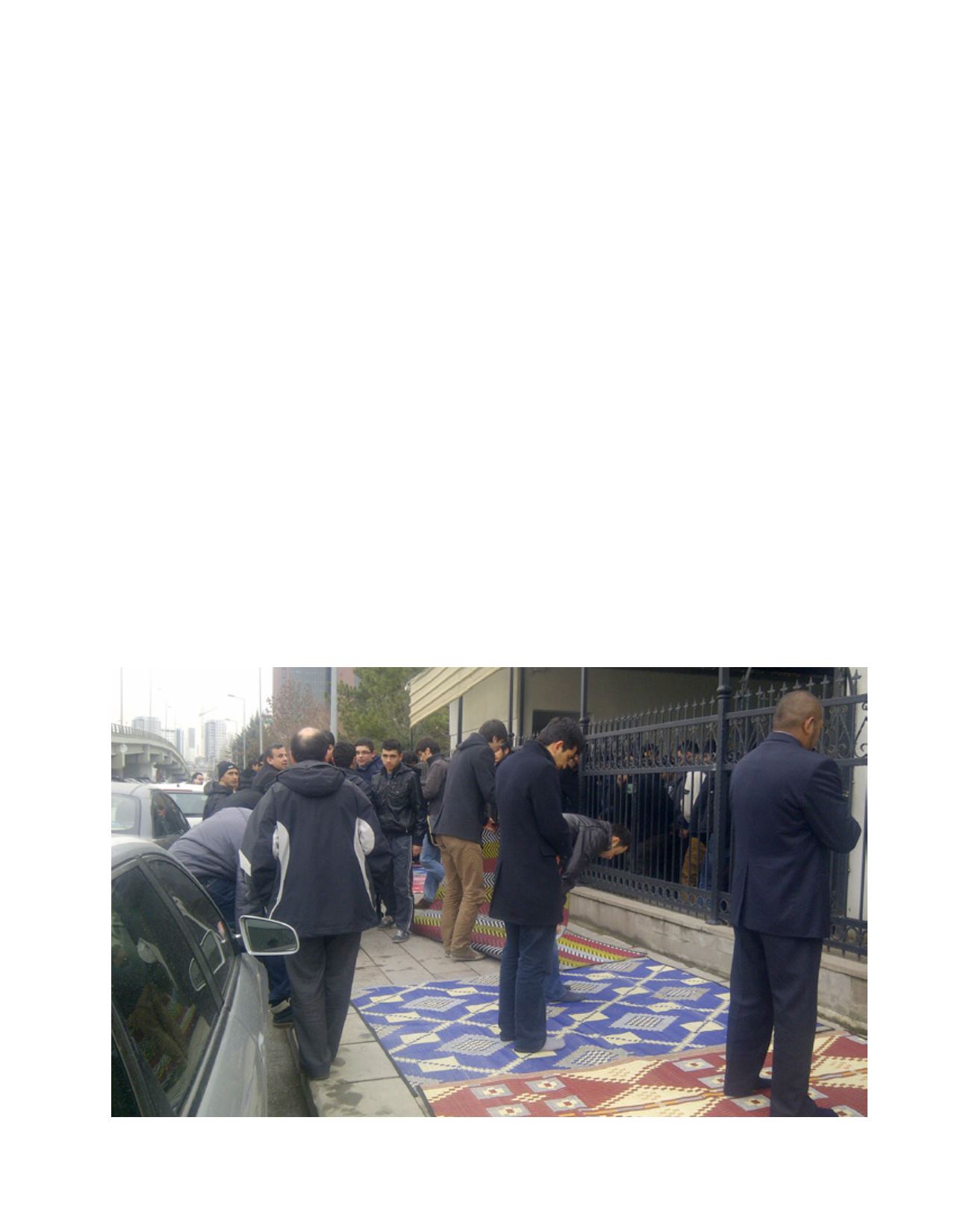
Students praying on the pavement in Ankara, Turkey