


 38 / 74

[
] 36
A B
et ter
W
or ld
of the invaders needed to be confronted, the centuries-old
slavish mentality of the natives also had to be addressed.
The Guru’s goal of ensuring justice and harmony in society
thus warranted emboldening the frightened, liberating the
superstitious, and equating the lowly. To execute his vision,
the Guru toured the country of his birth (pre-partition
India) and beyond its boundaries in what is now Pakistan,
Afghanistan, Iran, Iraq, Yemen, Syria, Jordan, Saudi Arabia,
Muscat, Oman, Tibet, Bhutan and Sri Lanka, to interact with
religious leaders and their followers. He was deeply revered
by all for his message of love and equality. No wonder that
when he passed away, both Hindus and Muslims asserted
their claim to perform his last rites in the way of their respec-
tive customs. A popular adage from the times says: “Nanak,
the rich indeed, unconcerned for worldly riches, he is the
spiritual guide of Hindus as well as Muslims” (
Nanak shah
faqir, hindu ka guru, musalman ka pir.
)
The Guru defines a new level of existence for the masses
– to rise above social, religious, racial, caste and gender
denominations. People had to be made aware that equal-
ity is a birthright; the concept of superiority and inferiority
had to be purged; misogynistic frames of mind had to be
negated. As one of the measures, Guru Nanak introduced
free food to be partaken by all together, irrespective of caste,
status, gender, religion (
langar
and
pangat
) which, though a
simple practice, had far-reaching ramifications. It not only
catered for the needy but also ended the dehumanising
prejudices and discrimination practised in society. Even the
then emperor had to partake
langar
, before he was granted
an audience with the Guru. The Guru not only awakened
the people to lead a life of dignity, but also instilled in them
fearlessness and fortitude to safeguard the same. He exhorts
his followers thus: “If you want to play the game of love, then
come unto my path with thy head placed on thy palm. Once
on this path, then waiver not.”
10
The Guru respects diversity of cultures and religions as
the right of people to follow a religious path of their choos-
ing. The ninth Guru, Guru Tegh Bahadur (1621–1675), in an
unparalleled precedent, guarded this right when he chose
to embrace martyrdom for the sake of a people professing
a religion other than his own, who were being forcefully
converted to Islam by the Mughals. He thus affirmed this
right to choose with his life. India fittingly honours the Guru
by the title: “Protector of the Hindu nation” (
Hind di chaddar
).
The role of the tenth Guru, Guru Gobind Singh (1666–1708),
towards the right to freedom to religion can be gauged from
what Jogi Allah Yaar Khan, a renowned Muslim poet, writes
about him: “But for Guru Gobind Singh, all would have been
circumcised” (
Agar na hotey guru gobind singh, tau sunnat
hoti sab ki
).
Guru Gobind Singh practically carried the vision of Guru
Nanak to its culmination on the first of
Vaisakh
in 1699,
when he created the Khalsa – a people who are saint-soldiers
in the service of Almighty. For this, he invited the devout
from across the length and breadth of the vast regions to
assemble at Anandpur Sahib, Punjab, India. Of them he
asked, wielding his unsheathed sword (
kirpan
), for one to
rise who was ready to give his head for the Guru’s cause.
One rose and came forward. The Guru took him behind a
tent and re-emerged with his blood-soaked
kirpan
to ask
for another head. People were aghast, yet one more rose and
offered his head. He repeated the call five times, and five
individuals responded. To everyone’s surprise, the Guru
then presented all five to the congregation, in a new outfit.
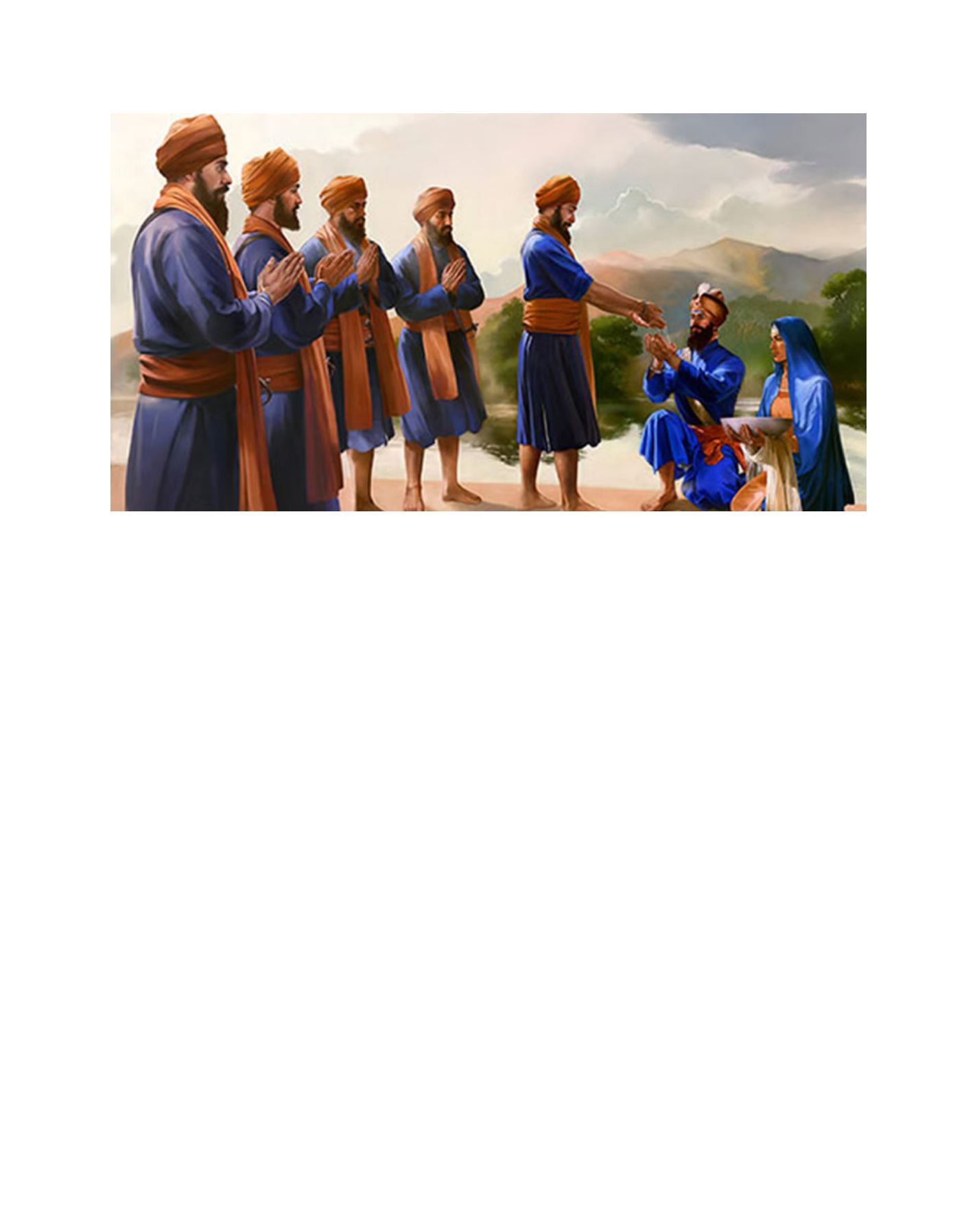
He initiated them by a special ceremony (
khande di pahul
)
11
into the Khalsa brotherhood, and bestowed the title “The
Image: www.artofpunjab.com
Guru Gobind Singh seeking initiation from the
panj pyaras