


 41 / 74

[
] 39
J
ust
, P
e aceful
and
I
nclusi v e
S
ocieties
Sustainable development in the Islamic world
through social finance
Dr Mohammed Obaidullah, Senior Economist, Islamic Research and Training Institute,
Islamic Development Bank Group
T
he Islamic world is enormous, with over 1.6 billion
people, or 23 per cent of the global population, accord-
ing to the Pew Report, 2015. It stretches from Senegal
to the Philippines, and comprises six regions: North Africa,
Sub-Saharan Africa, the Middle East, Central Asia, South
Asia, and Southeast Asia. Except for several countries in
Southeast Asia and the Middle East, there are high and rising
poverty levels in both urban and rural parts of most Muslim
countries. It is estimated that just five of the member coun-
tries of the OIC and the Islamic Development Bank (IsDB)
Group account for over half a billion of the world’s poor.
Poverty levels have also been associated with high inequality
alongside low productivity.
The Islamic world also faces grave challenges from climate
and environment changes. For example, a sizable number,
nineteen of the member countries of OIC and IsDB Group
from Sub-Saharan Africa, are dependent on agriculture, and
are affected most by climate change. It is estimated that in
Sub-Saharan Africa, a one-degree rise in global temperature
causes a 1.9 percent reduction in annual growth. Further, the
most vulnerable countries have historically been low carbon
emitters although these have also experienced steady emis-
sions growth. Emissions in these countries have more than
trebled over the last two decades. The sustainable develop-
ment goals (SDGs) that set an agenda or a plan of action for
people, planet and prosperity and target extreme poverty as
well as climate change risk, therefore, assume grave signifi-
cance for the Islamic world.
The SDGs and Shariah-driven finance
While poverty is widespread, access to financial services in
the Islamic world is either inadequate or exclusive. In as many
as 17 countries only one-fifth or less of their adult popula-
tion has access. Among other things, a factor contributing to
financial exclusion in the Islamic world is the incompatibility
of conventional finance with belief systems in these societies.
A CGAP survey undertaken in several countries with a signif-
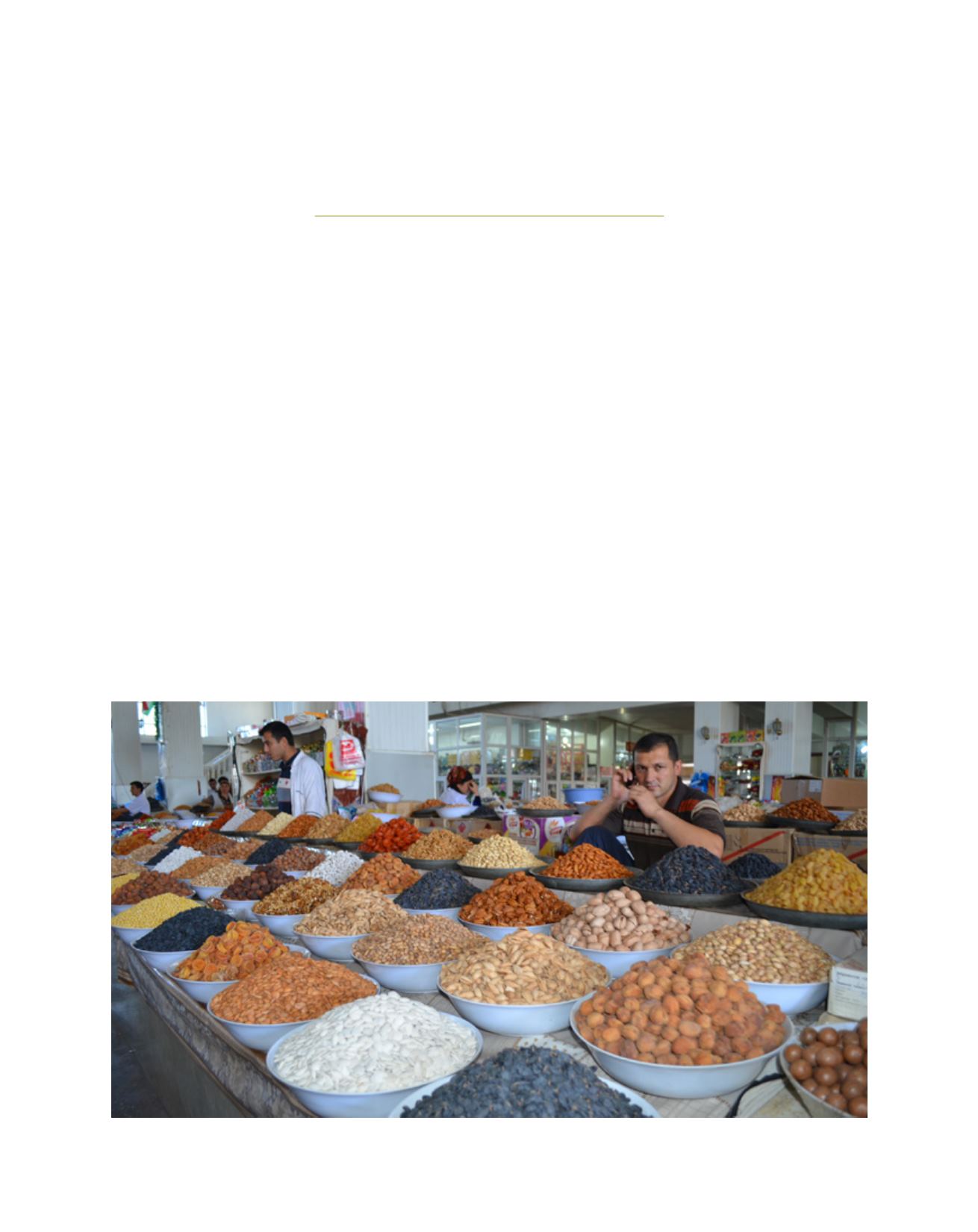
Small vendors at Dushanbe