



 36 / 74

[
] 34
A B
et ter
W
or ld
A massive plan of conscientisation was also required. Mr
Snehajan sought the help of psychiatrists and public health
officials to assist him in the task of organizing a series of
classes on gender based violence and the scope and poten-
tial of panchayats to combat it. Trainers were themselves
trained who then conducted their training programmes at
ward level. At the end of the programmes, a professionally
designed questionnaire was distributed to a total of 4,881
women and girls seeking information on the prevalence of
sexual assault; the type, timing and frequency of assault; the
specific spaces in the panchayats where the incidents took
place; the relationship of perpetrator to victim; the justice-
seeking behaviour of the victim; the reasons for not seeking
justice; and the impact of violence on the victim and family.
The information generated was used to design projects which
had the legitimate back up of the study which extended over
three months in 2011. 60 per cent of respondents reported
sexual harassment. Crime mapping was carried out and the
danger zones within the panchayat were identified.
The
Jagratha samithies
(a voluntary vigilant group of citi-
zens which act as the eyes and ears of the Kerala Women’s
Commission) were revived and revitalised. Unsafe areas were
made safe, for example by clearing wildly grown vegeta-
tion and planting tapioca. The panchayat set up a Women
Resource Centre with a library. A psychologist regularly
visited the centre and gave counselling to women. A legal
aid clinic was set up to give free legal aid and legal coun-
selling. Lawyers from an approved panel visited the centre
regularly. Thus, women were given a public space to nurture
their social capital which would be useful, especially in cases
where they had to stand up against violence.
In Kerala, schools (except high schools) were handed over
to the grama panchayats. The panchayat launched an exten-
sive scheme of Taekwondo training for the mothers of girls
in the school who in turn trained the girls for self defence.
Wherever there was a gap, they sought help from the state
government in Trivandrum and even from central govern-
ment in Delhi using their political connections.
Autonomy was given to ward members to conduct experi-
ments in their own ward. One ward member declared her ward
as alcohol free with the participation of the citizens. The formal
launching of the project was marked with a candle lit proces-
sion with beating of drums. The message of zero tolerance of
violence against women was transmitted loudly and clearly.
The network of police, lawyers and the elected representatives
materialized in the course of various training programmes and
activities. There were incidents where this network and the
newly constituted mechanisms were beneficially used to detect
and eradicate practices such as the illegal brewing and serving
of liquor. The crime rate declined steadily. The model attracted
the attention of central government, researchers and the
international community, including UNICEF. BRICS (Brazil,
Russia, India, China and South Africa) delegates visited the
panchayat. Citizen ownership and wide acclaim sustained the
project through the political changes. Out of the total plan
allocation in the panchayat, 63 per cent are women-orientated.
To summarise, the model has shown the following to be
the necessary ingredients for success and sustainability:
inspired and visionary leadership at local level; research-
backed project planning; the gathering of appropriate
professional help; political support from the top especially
up to the stabilization stage; prudent networking; ownership
and participation of the community, from problem identifica-
tion through to the implementation of solutions; integration
of the project into plans budget at local level; gender budget-
ing; winning the attention and approval at top level including
that of central government. This is a model that is replicable,
scalabale and adaptable.
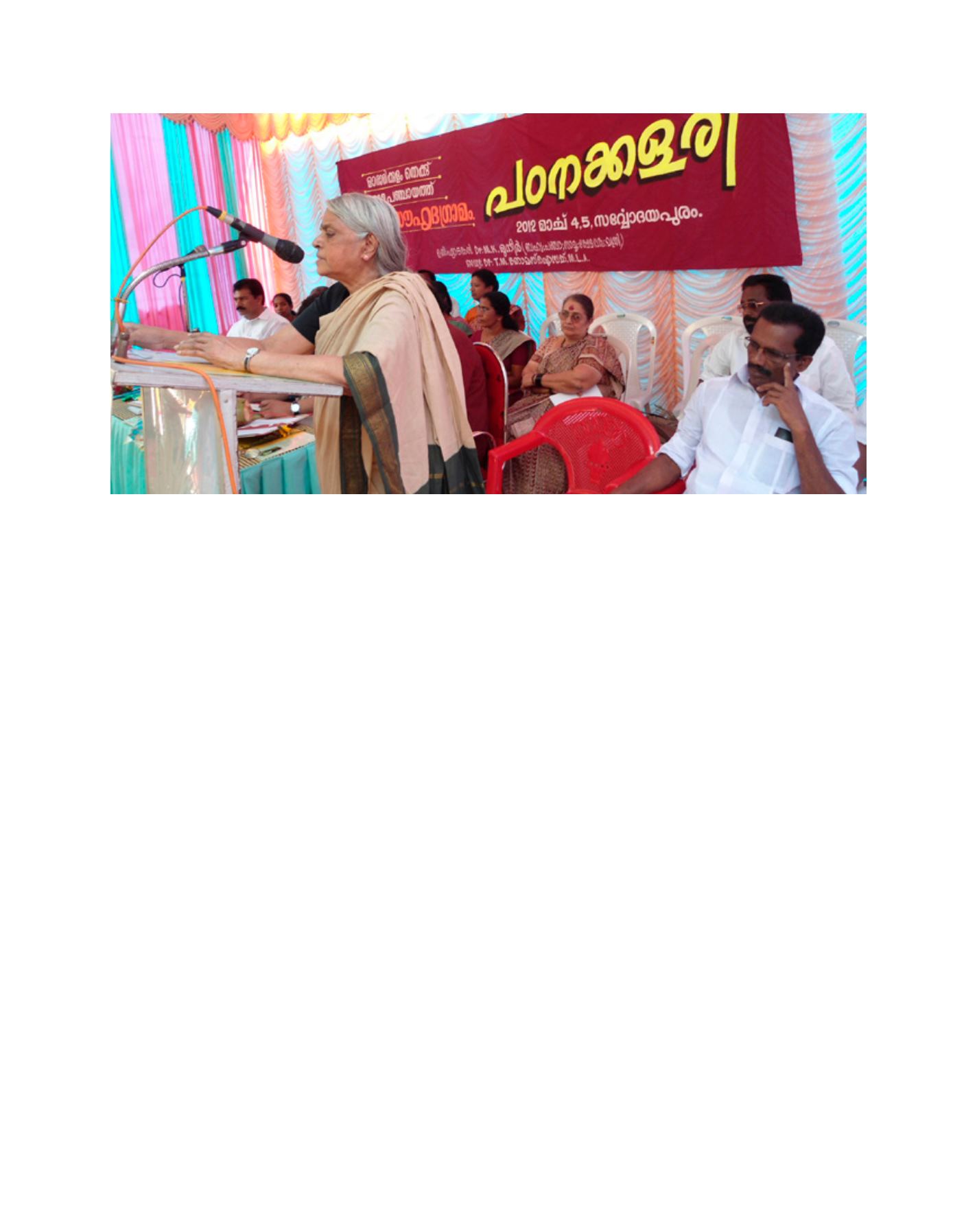
Sugatha Kumari, poet, social activist and former chairperson of Kerala State Women’s Commission at the workshop
On the Way Forward
, 4 March 2012
Image: South Mararikulam Grama Panchayat, Alappuzha District, Kerala, India