



 37 / 74

[
] 35
J
ust
, P
e aceful
and
I
nclusi v e
S
ocieties
One planet, one family – the Sikh path to a just,
peaceful and inclusive world
Dr Birendra Kaur, Vice President, Institute of Sikh Studies
T
he Sikh scripture, Guru Granth Sahib,
1
states: “The
world is like a garden (of flowers) and God is the
Gardener.
2
Not a single leaf or branch is outside His
care.”
3
His love is universal; unconditional and all-encom-
passing.
4
Guru Granth Sahib itself is an embodiment of
an all-inclusive worldview as, apart from divine hymns of
Sikh Gurus, it also enshrines selected hymns of Hindu and
Muslim pious souls, irrespective of their religion, caste or
place of origin. The core message is the parenthood of God
and siblinghood of humankind.
Guru Nanak (1469–1539 CE), the founder of Sikh Faith, dedi-
cated his entire life to bringing humanity under the umbrella
of One Supreme Being. His opening words in Guru Granth
Sahib are “One God” (
Ek Oankar
). The numeral ‘1’ prefixed
to
Oankar
emphasizes the singularity of the creator of the
entire creation. Its corollary is the uncompromising oneness
of the whole human race. This message echoes throughout
Guru Granth Sahib: “God of all is One and the Only One.
5
From the One Light has welled up the entire universe, then
who is good and who is bad?
6
All creatures are noble; none
low, as One Sole Maker has fashioned all vessels.”
7
The Guru claims no exclusivity for the path laid down, the
prayer being: “O Lord, the world is on fire; shower Thy bene-
diction to save it; deliver it through whatever way possible.”
8
The Guru envisions a world where everyone enjoys equality
and dignity, and where harmonious coexistence is the order
of the day.
9
Guru Nanak not only recorded his message for
humanity but also put in place institutions, which would
serve and propagate his ideals for posterity, and bring about
sustainable transformation in society.
People, in his times, were either oppressors or the
oppressed. The natives were not only tormented by foreign
rulers but also agonized by the local religious elite. They
were categorized within a social order by birth, and blinded
by superstitious beliefs. Thus, while the inhuman brutality
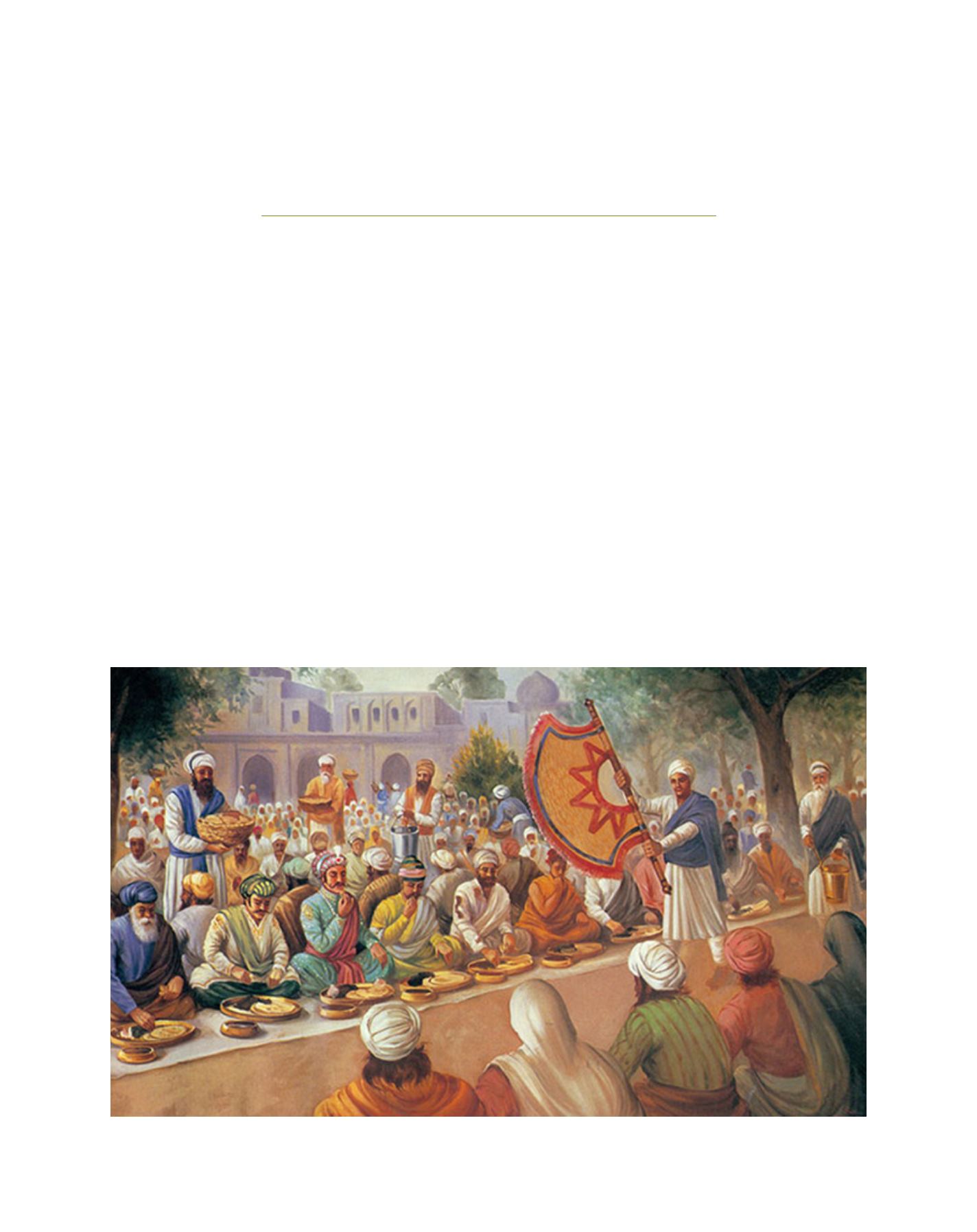
Image: www.goldentempleamritsar.org
Emperor Akbar partaking of langar before meeting the third Guru, Guru Amar Das, 1479–1574