



 35 / 74

[
] 33
J
ust
, P
e aceful
and
I
nclusi v e
S
ocieties
The South Mararikulam model – a women-friendly
panchayat project
Dr Neena Joseph, Former Professor, Institute of Management in Government
K
erala state in India is unique, in relation to the
whole of the country, in its exemplary achievements
towards gender parity within the health and educa-
tion sectors. But its record of safety and security of women
against sexual assaults is dismal, considering the density of
crimes. When Mr NP Snehajan became president of South
Mararikulam panchayat, he vowed to combat violence after
an extensive tour of the panchayat revealed strong evidence
of cases of brutality.
South Mararikuam panchayat is an elected local body (
grama
panchayats
) in the Alappuzha district of Kerala, India. With
the 73rd and 74th Amendment of Indian Constitution, local
bodies in the country, were given statutory power as local
self governments with the funds, functionaries and func-
tions devolved to grassroots level. Each grama panchayat is
divided into wards and in each ward there are elected repre-
sentatives or ward members. At the grama panchayat level,
there is a committee which is constituted by the elected
members from each ward. In Kerala, the government had
initiated and supported community based organisations at
the level of panchayats, wards and neighbourhoods through
Kudumbasree – the Kerala State Poverty Eradication Mission
launched in 1998 and inaugurated by the then prime minister.
Mr Snehajan, believed that unless the safety of women can
be guaranteed within the panchayat, they could not partici-
pate effectively in its affairs and, unless this 50 per cent of
the population could participate effectively, then social devel-
opment is impossible. His first initiative as president was
to ensure a sexual abuse-free environment for women. He
adopted a multi-pronged strategy of preventive, curative, reha-
bilitative and ameliorative initiatives. He strongly believed in
lobbying and networking for the fulfilment of his dream. He
knew that he could utilize the existing structure and system
as well as the human power to accomplish the objective. He
sought the help of the then member of legislative assembly, Mr
Thomas Isaac and also consulted the essential professionals.
All of the existing strengths of the system were utilised and
opportunities offered by the system were exploited.
The grama panchayats had to make their own plans and
budgets. The first step was to legitimise the initiatives and
to incorporate them into the panchayat plan and budget.
Gender budgeting was paramount, with ample provision for
women oriented projects.
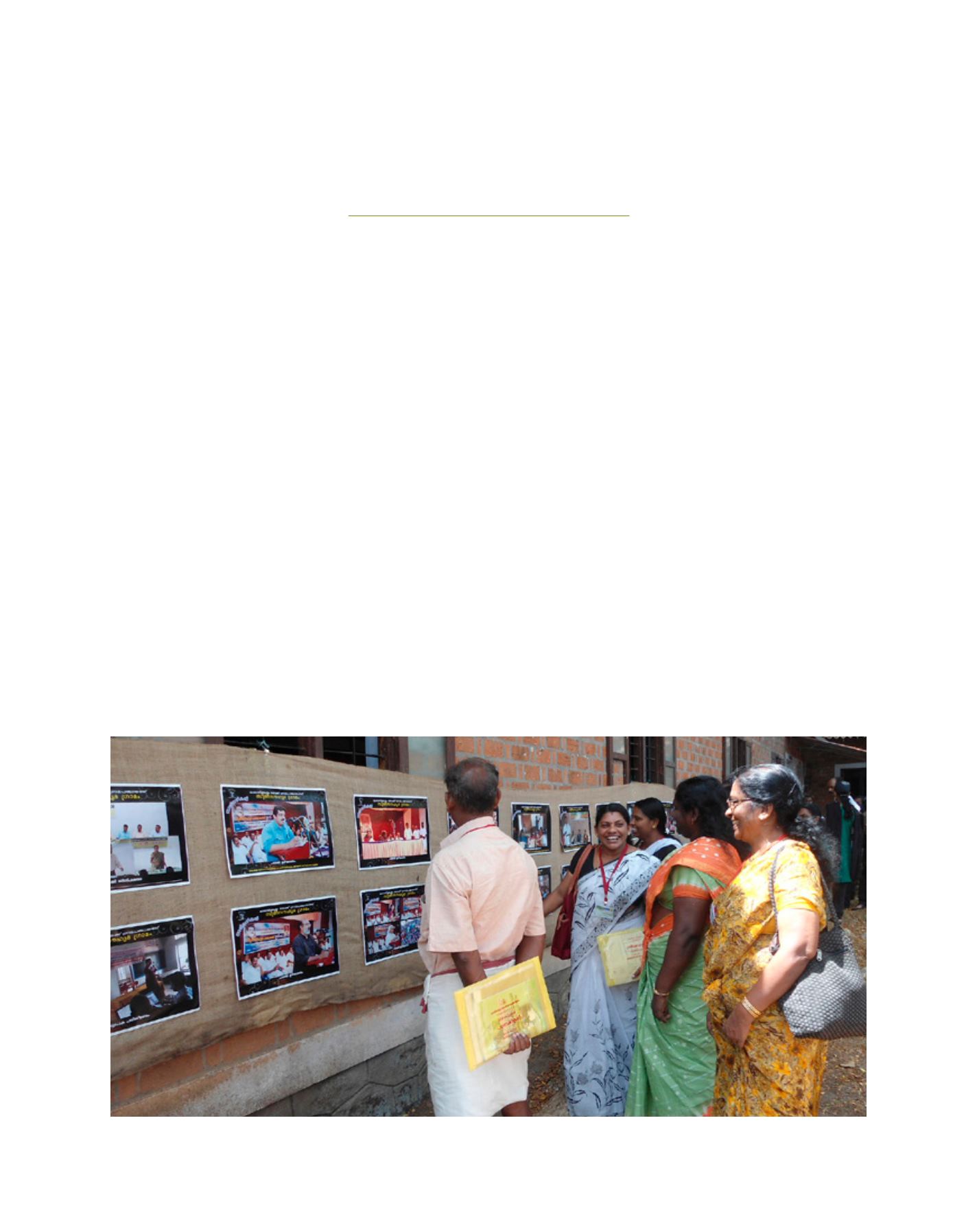
Enthusiastic public participation in the photo exhibition
Highlights of the Research and Actions Thus Far
, 4–5 March 2012
Image: South Mararikulam Grama Panchayat, Alappuzha District, Kerala, India