


 39 / 74

[
] 37
J
ust
, P
e aceful
and
I
nclusi v e
S
ocieties
five beloved ones” (
panj pyaras
) on them. Common surnames
were given – Lion (
Singh
) to men and Crown Prince (
Kaur
) to
women. The Khalsa consider themselves siblings, as children
of Guru Gobind Singh and Mata Sahib Kaur, and their place
of birth as Sri Anandpur Sahib. Thus was created a broth-
erhood in the true sense, which everyone was welcome to
join by committing to its value-system. Taking equality to its
height, the Guru merged his own status into the
panj pyaras
,
as he bowed before them and sought initiation for himself,
symbolising equality of not only different peoples but also
of the Guru with the
panj pyaras
. Guru Gobind Singh is the
prophet who is hailed with: “Wow! Wow! Guru Gobind
Singh! He is himself the Guru, himself the disciple!” (
Wah!
Wah! Guru Gobind Singh, aapey gur chela
).
A society beyond caste, region, religion and race was born,
dedicated to justice, righteousness, inclusiveness for all – all
people, all equal. Thousands joined the Guru’s new order on
the same day. The Guru also bestowed five freedoms (
nash
),
upon his followers and liberated them from the shackles of
oppressive and derogatory practices and notions: hierarchy
through lineage (
kul nash
); subjugation by religions and
traditions (
dharma nash
); superstitions, prejudices (
bharam
nash
); restrictions in choice of trade or profession (
kirt
nash
); and burden of previous deeds, births (
karam nash
).
The Guru, thus, created a people who are physically fear-
less, mentally enlightened, and spiritually elevated, who see
the entire human race as one. “None is a stranger, nor an
enemy.
12
None is alien, all are equal partners.”
13
A Sikh sees God in all, and his love for the Almighty
finds expression in acts of service and love for His creation.
“Selfless service to the people of the world is the route to earn
pleasure of God.”
14
Altruistic service, therefore, manifests
itself in Sikh practices. A gurdwara is the place of refuge for
one and all, where food and shelter is available to whosoever
seeks it. The daily prayer in all gurdwaras across the globe
is for the welfare of all (
sarbat da bhala
). Whether friend or
foe, none is discriminated against, and nothing in return
is expected – neither in cash nor in kind. To cite a recent
instance, during the cash crunch and the hardships that
followed demonetisation in India on the 8
th
November, 2016,
some stranded tourists commented: “Thank God India has
Sikhs.” Even though Sikhs comprise less than 2% of India’s
population and less than 0.4% of the world’s population, they
are always at the forefront of reaching out to the hungry and
the needy, especially in times of emergency or natural calam-
ity and in terror-struck or war-torn regions.
The diaspora Sikhs, too, have made their presence felt in
their new homelands, as their value-system and contributions
to society are acknowledged and appreciated by the highest
offices. The Prime Minister of Canada, Justin Trudeau, issued
the following statement on the occasion of Vaisakhi, 13
th
April,
2016: “Sikhism is rooted in teachings of equality, unity, selfless
service and social justice – the very values which we all strive
to incorporate in our daily lives. Canada is proud to be home to
one of the largest Sikh populations in the world, and we thank
the community for the immense contributions it makes to our
country.” The British Prime Minister, Theresa May, on the
occasion of the 350th anniversary of the birth of Guru Gobind
Singh, 5
th
January, 2017, mentioned: “…the establishment of
the Khalsa, and what it represents – people standing up for
equality, respect and fairness, and helping those less fortunate
than themselves. Time and again I have seen these values put
into practice, from visiting Gurdwaras to attending the Sikh
war memorial in Derby. Indeed, when we celebrate Vaisakhi
soon, we will be reminded once again how the teachings of
Guru Gobind Singh ji enrich our wider society.”
“Air is guru, water the father, earth the mother, and day
and night the two nurses – female and male, in whose lap
the entire world plays.”
15
When nature nurtures all alike,
and we all play in the same lap, we undeniably are, by an
innate design – one planet, one family. However, the recent
trend, even within democracies, is marked by separatism and
elitism. Borders may shut out peoples, but these will prove
ineffective against ever increasing incidences of disease, ever
rising levels of pollution, ever advancing means of warfare.
No country would be able to isolate or insulate itself indefi-
nitely. Vision demands that we see our inevitable future, and
configure our approach accordingly, and in time.
One planet, one family is the only way forward for human-
kind. We need to embrace globalisation as working towards
welfare for all, where none is discriminated against or
exploited, so the garden of God may be created on earth.
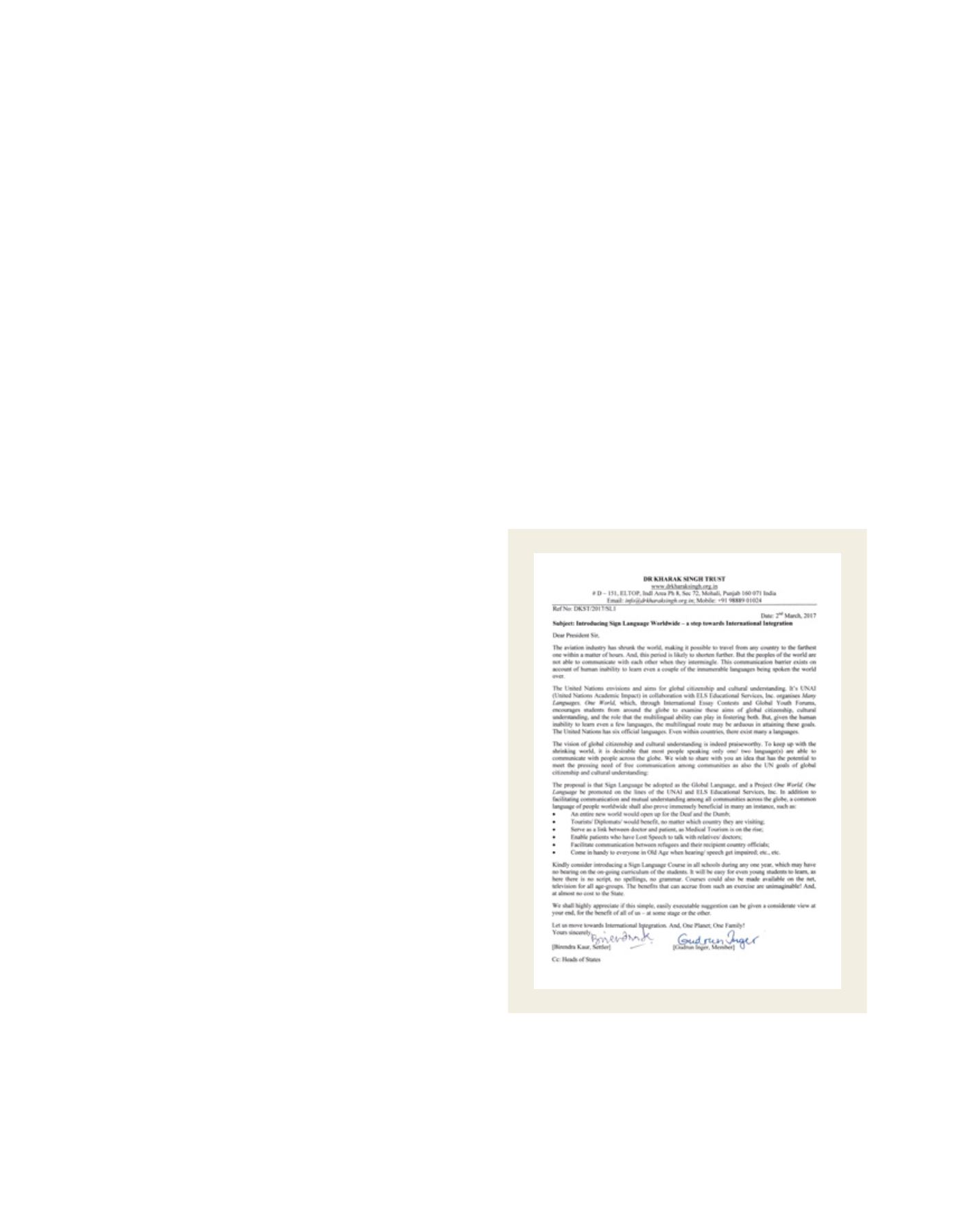
Pictured overleaf: Letter from Birendra Kaur to Ban Ki-moon, sent in
December 2016, while he was in office as Secretary General, UN, before
Antonio Guterres took office in January 2017
Letter for promoting intercultural and international understanding, sent from
Birendra Kaur to heads of state and to UNAI and ELS Educational Services