


 45 / 74

[
] 43
J
ust
, P
e aceful
and
I
nclusi v e
S
ocieties
these projects with the firm support of its Member States,
the Council attributes utmost importance to strong, genuine,
broad-based partnership and solidarity as well as experience
sharing, technical assistance and exchange of good practices
in designing and implementing its activities.
An example of this cooperation among council members is
in the field of tourism. Since December 2013, with the initia-
tive of the Turkic Council, the Turkish Ministry of Culture
was able to share its vast experience of the services sector
through vocational training programmes run for tourism
employees of Azerbaijan, Kazakhstan and Kyrgyzstan.
Through these programmes, Turkey’s rich know-how and
experience have been transferred to other Member States.
More than 1000 tourism employees benefited from the train-
ing. Almost 50% of trainees were female. The training was
instrumental in developing skills for high-quality hospital-
ity services and contributed to generating good jobs in the
Turkic Council Member States, addressing SDG 8 – promot-
ing sustained, inclusive and sustainable economic growth,
full and productive employment and decent work for all.
The training empowered the Turkic Council Member
States, making a success of the implementation of the Turkic
Council Modern Silk Road Tour Package Project that offers a
unique journey along the traditional Silk Road. This project
will also contribute to rural development in the Turkic
Council Member States through various means.
Joint training programmes for junior diplomats present
another remarkable example of the efforts of the Turkic
Council for capacity building through exchange of expe-
rience and best practices. These programmes have been
implemented annually in accordance with the Cooperation
Protocol among the Ministries of Foreign Affairs signed at
the Third Summit of the Turkic Council.
The main purpose of this exercise is to acquaint young
diplomats with the foreign policies and commonalities of
history, culture and language of the Member States, as well
as to establish friendly ties. The content of the training is
generated annually by the Secretariat of the Turkic Council
taking into consideration the priorities of the Council and
the host country, based on the experience and comments
of the participants of the previous programmes. One of the
Member States hosts the two-week training which consists
of lectures by academicians, top government officials
and high ranking diplomats; cultural tours to historical
places and official visits. The Third Junior Diplomats Joint
Training Programme was held from 25 May to 5 June 2016 in
Kazakhstan. Hungary, as the first non-member country, also
took part in the Programme. The next training programme
is planned to be held in Kyrgyzstan in 2017.
For the Turkic Council, capacity building has a special
stake in the field of economics. The Council prioritizes devel-
opment and enhancement of SMEs, empowerment of human
capital through capacity building and use of effective tools
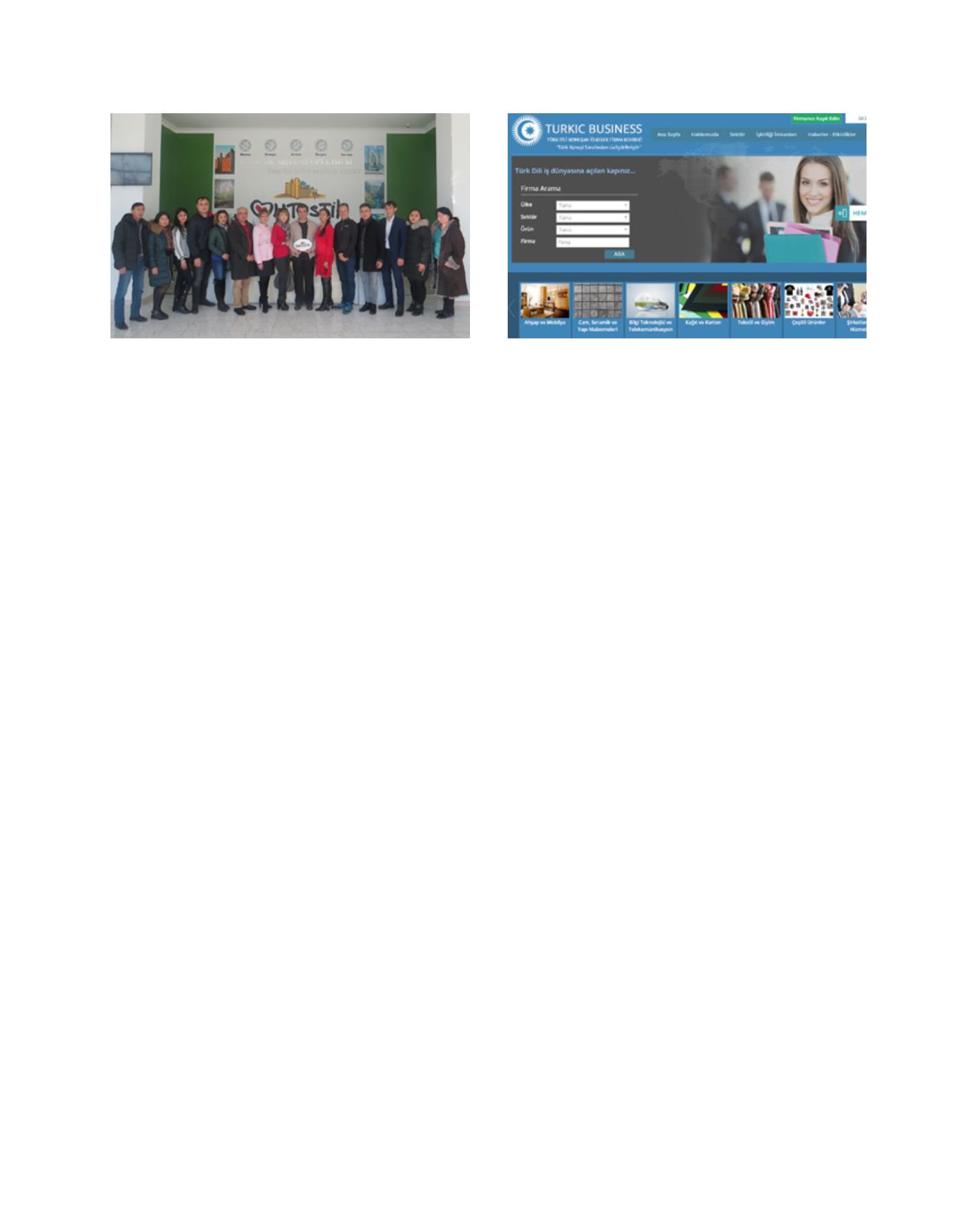
for research. Hence, the Turkic Business Forums regularly
convened by the Council, and the Turkic Business Portal
(www.turkicbusiness.com)where more than 220 compa-
nies have been registered to enhance capacity of Member
States in different segments of the economy. The Fourth
Turkic Council Business Forum convened on 28 April 2016,
in Bishkek was attended by more than 100 business people
from Member States representing the fields of the mining
industry, energy, tourism, agriculture, food processing and
light industry. Also, an initiative of the Turkic Council, in
cooperation with the Islamic Development Bank, has been to
create a mapping study of the resource centres of Azerbaijan.
The Council believes that, through this and similar projects,
it will contribute to identification, matching and exchange
of solutions for further fostering development cooperation in
and around the region.
Customs cooperation is another area where the Council
focuses on capacity building. Through field visits, the
Council analyses the needs of Member States to bolster
collaboration in this area. For instance, in order to promote
joint actions and projects to strengthen customs coopera-
tion among the Silk Road countries, visits by delegations
from Azerbaijan, Turkey, Kazakhstan, Kyrgyzstan and the
Turkic Council Secretariat were made between 27 and 29
September 2016 to Kyrgyz-Chinese Torugart and Kazakh-
Chinese Altynkol border crossing points as well as to the
Khorgoz Free Trade Zone located on the Kazakh-Chinese
border. These field visits were instrumental in making needs
assessments and tailoring capacity building solutions.
Another important element of capacity building is educa-
tion. In 2016, the Council launched the student exchange
The Republic of Turkey’s Ministry of Culture and Tourism continuously
provides service sector training for the other Turkic Council Member States
The Turkic Council Business Council web portal provides a platform for
collaboration between Eurasian businesses