


 46 / 74

[
] 44
A B
et ter
W
or ld
programme at high and secondary school levels. The First
Turkic Council Student Exchange Programme was success-
fully implemented by the National Ministry of Education of
the Republic of Turkey from 4 to 14 April 2016. Hosted by
Turkey, the programme provided students with the oppor-
tunity to learn each other’s traditions, culture, history and
educational processes, as well as to develop a sense of broth-
erhood and friendship. The Turkic Student Council that is a
subcommittee of the Turkic University Union comprising 16
universities from the Member States also carries out activi-
ties and exchange visits for the region’s youth. The exchange
programmes for students and academic staff is named the
Orkhun Process and focuses on capacity development
through experience sharing.
Sports constitute another area for capacity building among
the Turkic Council Member States. As was the case for the
First World Nomadic Games held in 2014, the Turkic Council
co-organized, along with the Kyrgyz Government, the
Second World Nomadic Games held from 3 to 8 September
2016 which constituted a remarkable celebration of diversity,
culture and intercultural dialogue with the participation of
over 1,400 athletes from 62 countries.
The next Turkic Council’s Heads of States Summit is
dedicated to youth and sports and so, throughout 2016, the
Turkic Council attributed a special emphasis to capacity
development in these areas within its Member States.
The 2030 Development Agenda stands at the heart of
the fruitful relations of the Turkic Council with UN and
its specialized agencies and offices, including UNDP,
UNOSSC, UNWTO and UNAOC with which the Council
has Memoranda of Understanding that focus on cooperating
for capacity building in our Member States and in the region.
The international conference, co-hosted by the Turkic
Council with the UNAOC, and held from 20 to 21 October
2016 in Istanbul, focused on the role of youth in preventing
and countering violent extremism. Here, the importance of
capacity building was strongly emphasised. UNDP, UNOSSC
and the International Center for Sport Security were among
the conference partners of the event that was attended by
more than 300 participants and speakers from 40 coun-
tries from Africa to Asia. An outcome of the conference
was the decision to launch a train-the-trainers programme
to empower youth in preventing and countering violent
extremism with the involvement of our Member States,
partner countries and relevant international organizations.
Topically and institutionally, the conference was a testimony
to the effective collaboration between the regional and inter-
national actors working hand in hand to prepare a better
future for the next generations. The Council believes that
young people are the game-changers in helping achieve the
SDGs, boosting South-South cooperation and preparing a
better future for all of us, leaving no one behind.
As far as the Council is concerned, capacity building is not
just about facilitating or conducting training or exchanging
experiences. It is a true investment to ensure sustainable devel-
opment in the region of the Turkic Speaking States and beyond.
It requires a tailored-made approach together with innovative
and sustainable methods. The Turkic Council is committed to
think regionally and act globally in this direction.
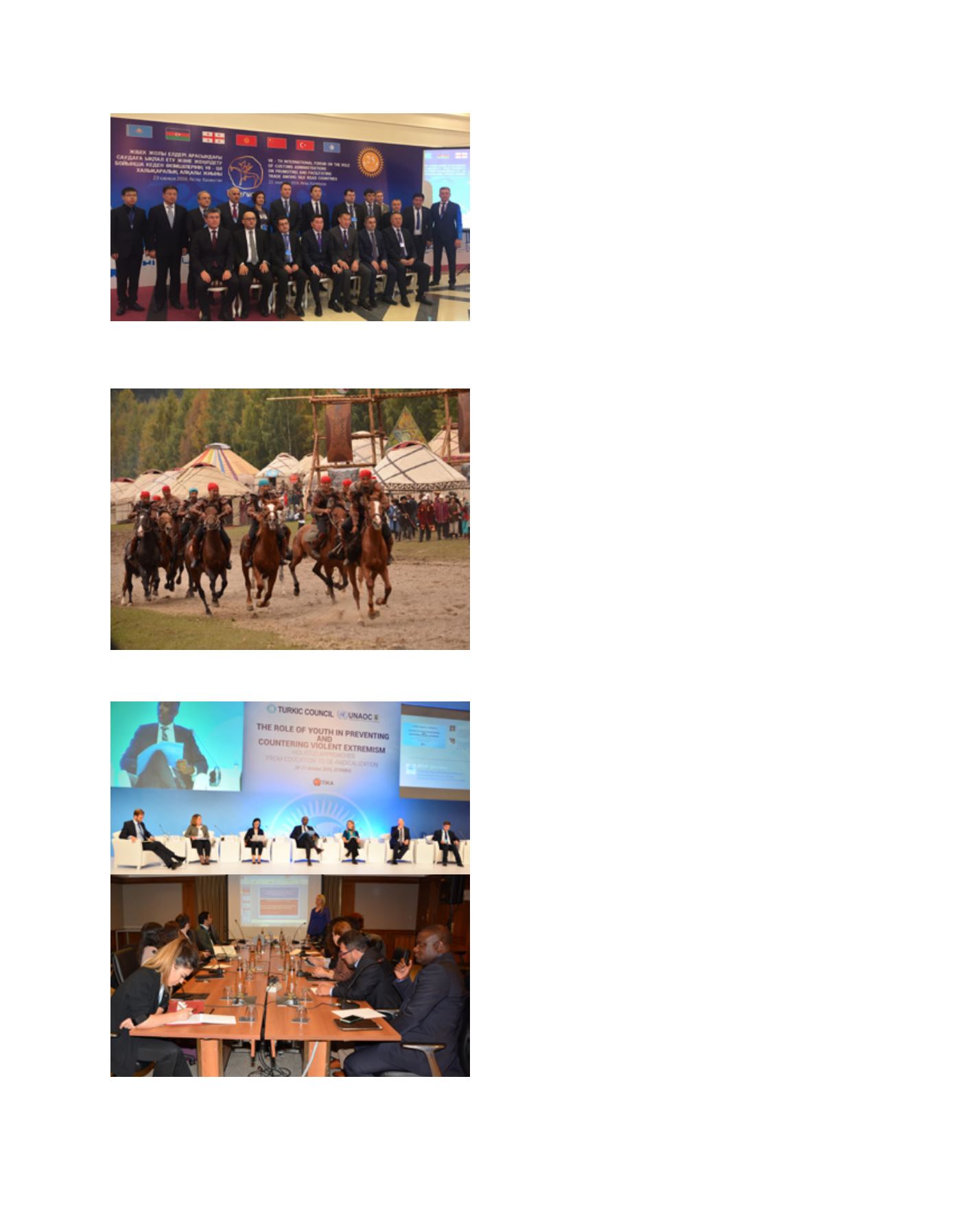
Cooperation in the area of customs and transport are one of the key areas
on the agenda of the Turkic Council, ensuring uninterrupted and secure
transportation through the central corridor via the Caspian Sea
Co-hosted by the Turkic Council and the UNAOC in October 2016, Istanbul,
the international conference on the Role of Youth in Preventing and Countering
Violent Extremism was attended by more than 300 young leaders and experts
from 40 countries, Africa to Asia
The World Nomadic Games brings sportsmen from all over the world to revive
the traditional sports of the Turkic speaking people