



 47 / 74

[
] 45
J
ust
, P
e aceful
and
I
nclusi v e
S
ocieties
Public participation and sustainable development
– unleashing the power of common people
Tevita G Boseiwaqa Taginavulau, Director General; M H Kawsar Rudro, Assistant Information and Communication
Officer, Centre on Integrated Rural Development for Asia and the Pacific (CIRDAP)
I
t is unfortunate, but clearly evident, that many of our
development efforts, despite our sincere commitment,
often fall short of achieving long-term impact. This is
largely down to the lens we see projects through and the
approach we take to address certain challenges. Instead of
‘enabling’ people, we often try to ‘help’ them without realiz-
ing that helping sometimes can do the opposite of enabling.
In other words, when we enable people, we don’t help people
by getting things done for them; rather we help them, with
a little push, so that they become able to help themselves
and address their challenges on their own with the least
possible external support. One of the most effective ways
to enable people is to engage people in the process, and
let them take ownership. Without participation and taking
ownership, people are likely to become passive beneficiar-
ies – dependent on others and less productive.
Stakeholders involved with policymaking should note that
ensuring public participation is not an easy task. The poor
and marginalized are often entrapped in certain inherited
structural arrangements where their capacity to participate
remains restricted due to undemocratic access to political
power and productive assets, limited capacity to participate
at different levels, and lack of incentives for involvement.
Consequently, these structural obstacles reduce the scope
and scale of participation, and thus exclude the poor from
reaping the benefits of development.
Participation is also key to transferring ownership to the
people. If we ask why numerous projects by government and
development agencies fail to achieve long-term impact, it is
because many of those projects and initiatives didn’t chalk
out the strategy for transferring ownership to the people.
Consequently, many initiatives simply finish once the project
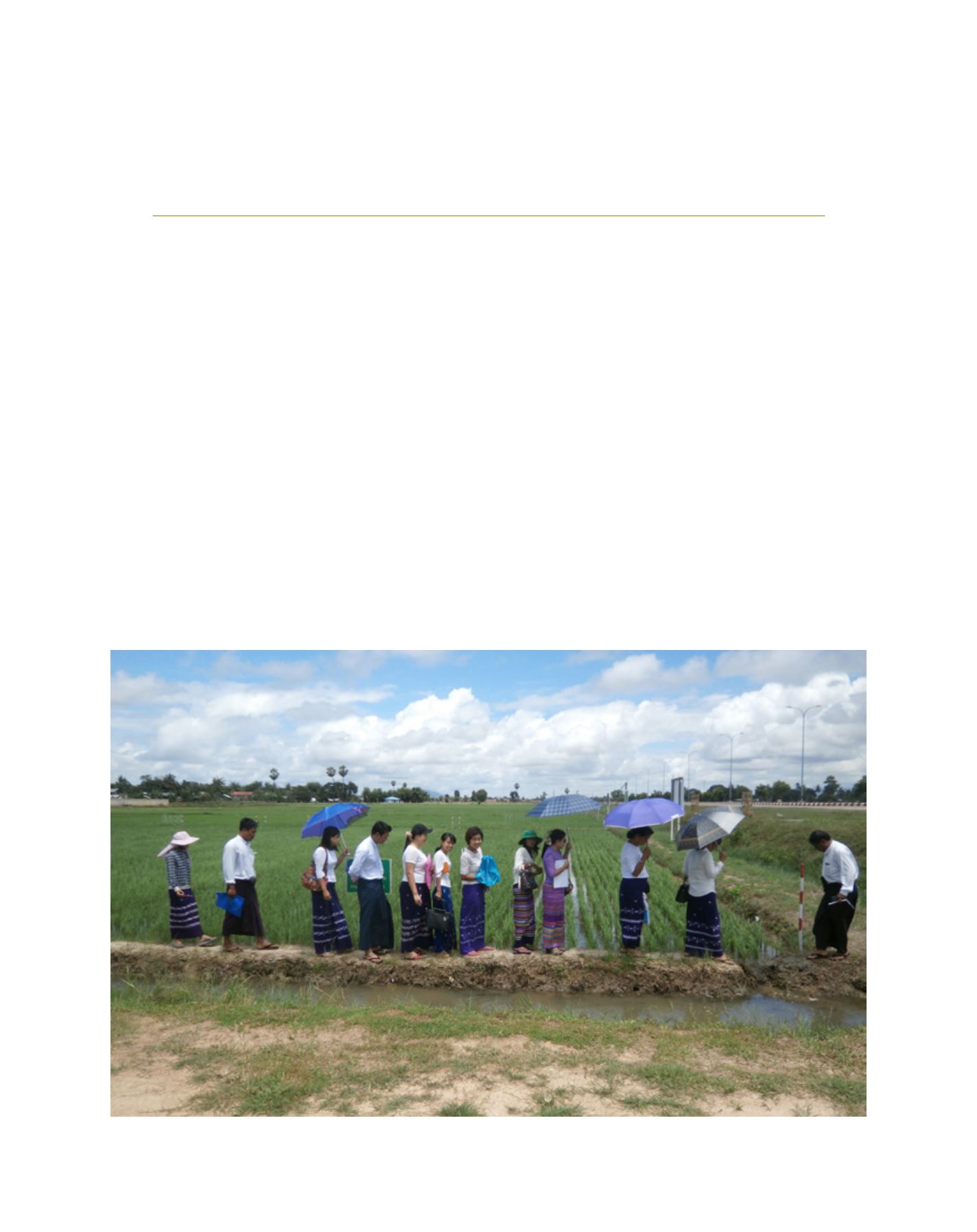
Participatory agricultural extension services for farmers in Myanmar
Image: Centre on Integrated Rural Development for Asia and the Pacific (CIRDAP)