


 56 / 74

[
] 54
A B
et ter
W
or ld
face. Before any frameworks are put in place, the roadmap
towards sustainable human development begins with recog-
nizing the innovation and capacity that already exists within
local communities, civil societies and governments. With or
without the help of the international community and donors,
local actors continue to play a significant role as innovators
and entrepreneurs, finding timely and effective solutions to
the challenges that only they best understand. The architec-
ture of all efforts towards global sustainable development
must therefore be inclusive of these local voices.
So how does the system develop a sustainable future? How
does the system ensure it is indeed the person in need who
ultimately inhabits this space of sustainability? How does
the system ensure local communities have the capacity,
resources and agency to address the challenges they face?
While the network does not claim to have all the solutions,
because of its members – who have worked directly with
communities, have an intimate knowledge and understand-
ing of their communities, and have been directly affected by
crises – NEAR is certainly better placed to design a locally-
led roadmap towards a sustainable future.
NEAR has already identified specific areas of work,
including advocacy, funding, organizational development,
and research in order to address the problems echoed by
many local and national organizations during its pre-launch
consultations. Of these, lack of direct funding and sustained,
long-term investment in the institutional capacity of local
and national actors, and representation at international deci-
sion-making forums emerged as some of the main challenges.
The issue of financing is key, and one that has been talked
about for a long time. It is intrinsically linked with the rest,
specifically capacity strengthening. While local and national
organizations are almost always the ones better situated to
respond in times of need, the bulk of global humanitarian
funding does not go to them. Currently, the system is central-
ized and dominated by UN agencies and international NGOs,
with multiple levels of subcontracting and intermediaries.
This means the amount trickling down to the person in need
is alarmingly low. If local and national organizations do not
have adequate and timely resources, it becomes difficult for
them to meet the needs of their communities. It is essential
to invert the way the system works so the person in need gets
the bulk of the resources.
During the 2016 WHS, commitments were made to address
the problem of financing. More specifically, the Grand
Bargain promised that by 2020, 25% of the global humani-
tarian funding would be directed to local organizations (5%
more than what NEAR was advocating for before the WHS).
This was indeed a win for NEAR, and for local and national
organizations.
Despite these commitments, the heavy lifting still has
to be done. There is the large responsibility of putting in
place mechanisms that ensure these commitments are
implemented, and there is also the responsibility of tracking
these commitments. How are the donors going to make sure
this 25% moves from commitment to action? How are they
going to make sure this 25% is going directly from donors to
local and national NGOs, and not through UN agencies and
INGOs as intermediaries? Of course, this raises the question
of who qualifies as a ‘local’ or ‘national’ NGO, and what ‘as
direct as possible’ means. It is important to address these
definitions in order to ensure the system does not fall into the
same vicious cycle it has been in, and that in the process of
addressing these current problems, it does not also perpetu-
ate the existing dynamics of power which continue to mute
the voices of those mostly affected. For this reason, it is
hoped that the people most impacted by these decisions will
lead the process of agreeing on these definitions and meas-
urements. For there to be truly a shift, these definitions need
to come from local and national organisations. The process
of naming southern NGOs cannot be led by northern NGOs
and donors.
Additionally, progress towards the Grand Bargain’s 25%
by 2020 cannot be made through UN and INGO managed
pooled funds. They are not directly accessible to local and
national organisations. NEAR has proposed redesigning
these pooled funding mechanisms from those that are north-
ern managed and driven, to ones that are managed by and
exclusively for local and national NGOs.
In this new model, not only will organisations have access
to financing, but they will also support capacity strength-
ening and due diligence. The amount allocated to each
organization will depend on how much it can absorb. A
long-term capacity strengthening strategy will be developed
to make sure the organization can absorb ever-increasing
amounts. This will ensure local and national NGOs have the
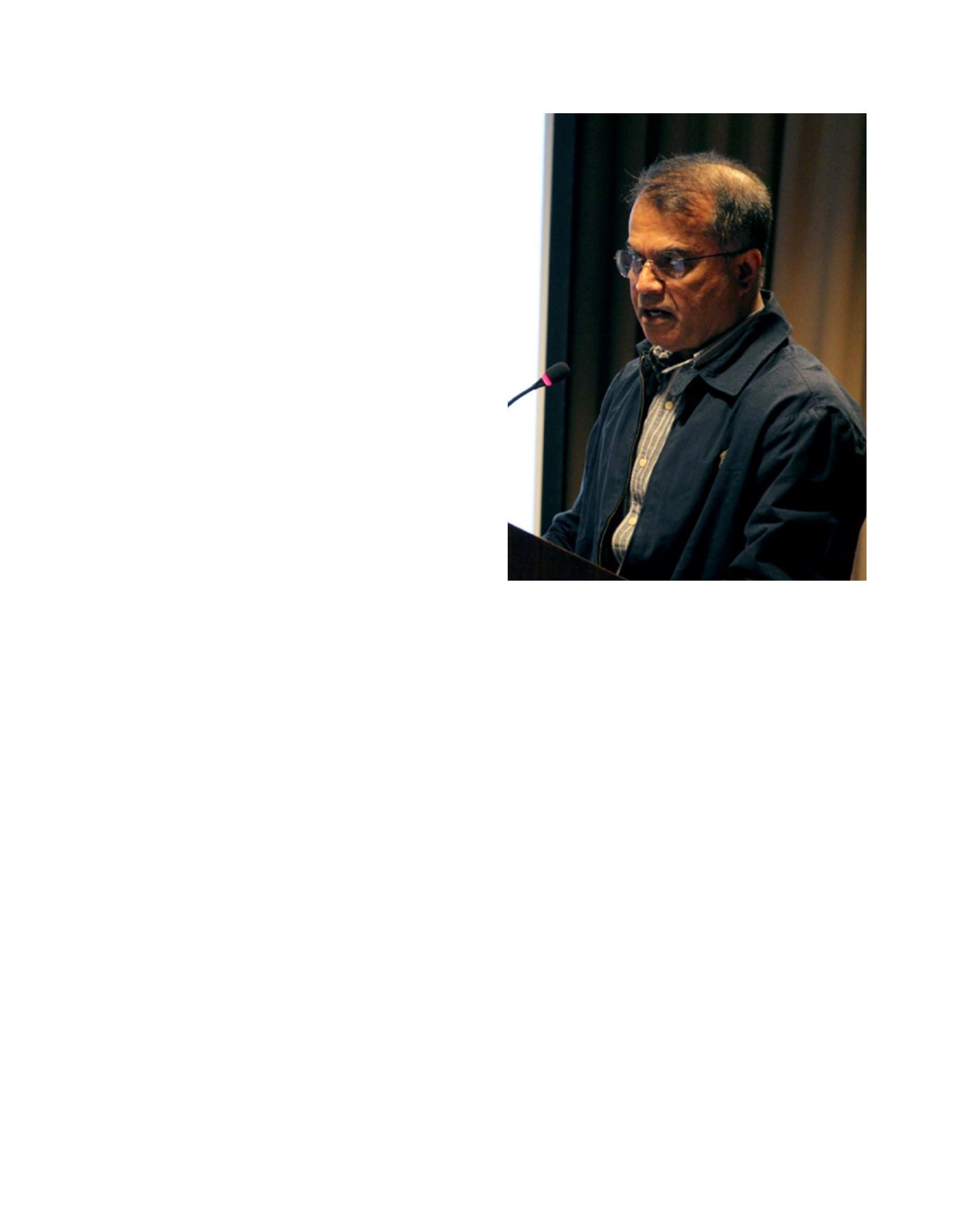
Rezaul Karim Chowdhury, Executive Director of COAST Trust Bangladesh and
NEAR’s treasurer, delivering the closing speech during the launch of NEAR at
the 2016 WHS, Istanbul, Turkey