


 61 / 74

[
] 59
J
ust
, P
e aceful
and
I
nclusi v e
S
ocieties
team sought to understand it empathetically. We refused to
regard the groups as monoliths. If in some cases, an Islamist
leadership figure harboured incurable hostility, his follow-
ers might nonetheless include many fundamentally decent
people, drawn to the organization by fear, lack of education,
or confusion. We also searched for evidence of elements
within a given Islamist movement that might be open to
positive change from within. The methodology which our
Monthly Books
have employed in scrutinizing their respective
topics is outlined below.
At a time of lethal sectarian and ideological conflict in
the Arab world, even some of the region’s finest scholars
feel compelled to pick a side. Once they have, the tone and
substance of their work becomes politically and emotionally
inflected. In our view, the inflection does not negate its value.
Rather than attempt to steer clear of partisan scholarship,
Al-Mesbar Center acknowledges and engages it. On any given
subject, we have published studies from a wide range of view-
points, and strived to achieve a larger balance by setting them
down side by side in a single volume, curating the texts along
the way. At the same time, we have been proud to nurture
scholarship that has risen high above the fray, approaching
the most heated subjects as close to dispassionately as any
vested party can. Viewed together, the diverse studies we
have supported are both a rare source of information and
analysis and an intellectual barometer of Arab and Islamic
politics today.
Over time, we began to move beyond Islamist movements,
to broader social issues in the region, as well as alternative
teachings about Islam from the wider Muslim world which
we felt might offer inspiration to the Arab heartlands. We
studied the status of women in our region – whether in indi-
vidual Arab countries, or, in the case of our
Monthly Book
,
Women After the Arab Spring, in the region as a whole
following a season of upheaval. We also pivoted from Islamist
movements to the study of Sufi movements, and the wisdom
and pathos they have brought to bear over the centuries and
to this day. In two volumes on Indonesia, we exposed Arab
readers to the beautiful syncretism of Islam and its spiritual
antecedents that has been forged and institutionalized on
that storied archipelago. In an analytical segment in the
Indonesia series, we suggested, in the broadest brush strokes,
that the Indonesian experience could offer some lessons to
Arab societies, particularly those that have always been a
mosaic of identities and sects.
In a similar vein, we also studied and celebrated the mosaics
themselves: the diversity of Islamic sects and practice in the
Gulf and other Arab countries; the history of Jewish commu-
nities in Kuwait and Bahrain; the living history of the Copts
in Egypt. In other volumes we asked how a few states in the
Arab world as well as the West have successfully managed
diversity. In doing so, we found exemplary models to inspire
our own local leaderships. Finally, we have also taken on
some of the lapses in humanity and human decency that
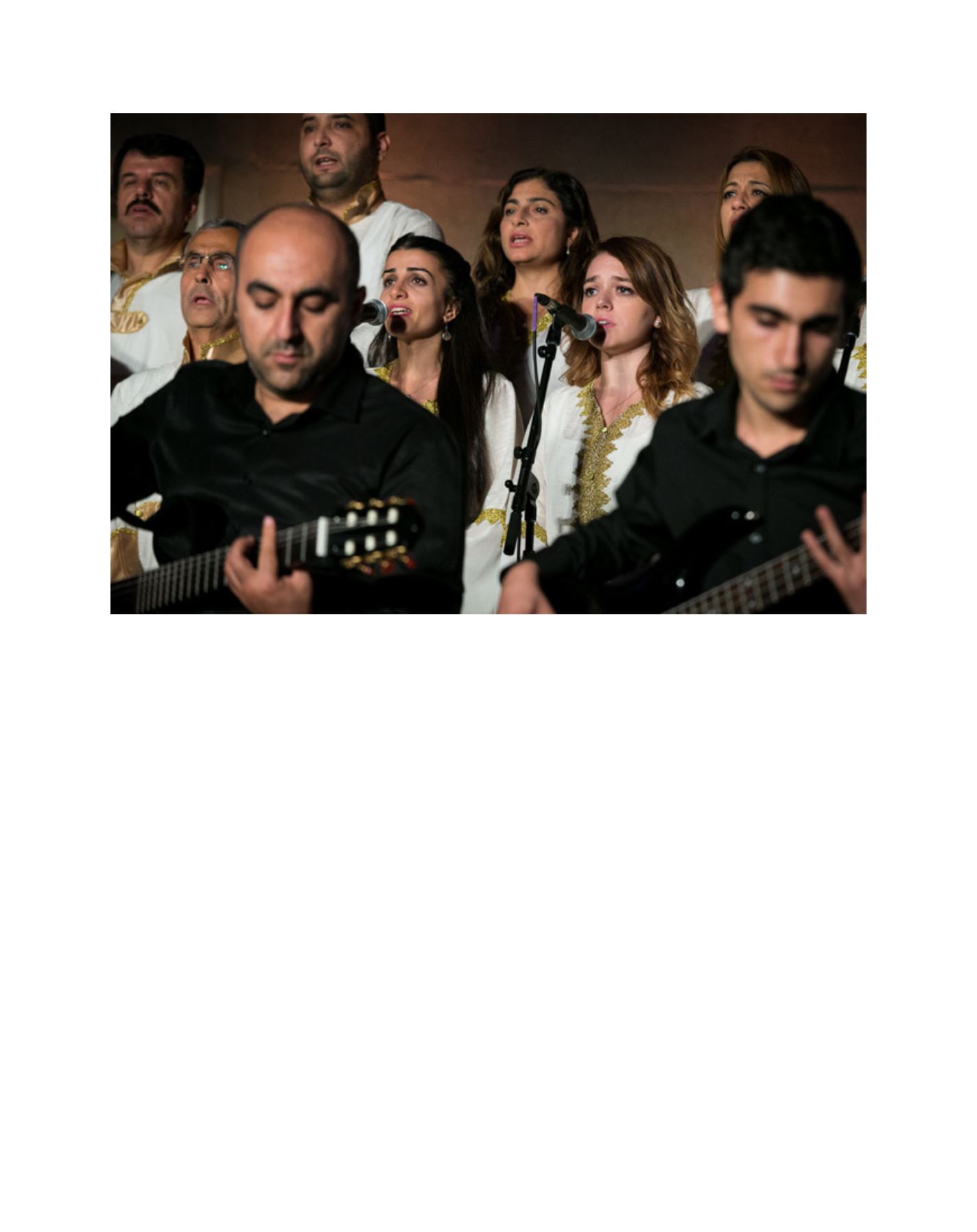
Al-Mesbar hosted a Turkish choir to sing psalms and nashids in English, Aramaic, Arabic, and Hebrew to celebrate tolerance between Abrahamic faiths
Image: Al Mesbar