



 59 / 74

[
] 57
J
ust
, P
e aceful
and
I
nclusi v e
S
ocieties
the freedom of CSOs is maintained with state discretion,
and restrictive executive implementation. Apart from that,
in some countries, the written constitution itself provides
implicit or explicit rationales for limiting associational free-
doms. This problem can be seen in many Asian countries. In
the cases below, constitutions make freedom of association
in compliance of national law. For example:
a The Afghan constitution on 26 January 2004 (ratified)
protects the right to form associations and political parties
“in accordance with the provisions of the law.” (Article 35).
b Cambodia’s constitution of 1993, with amendments through
2008, enshrines the right to establish associations and
political parties, but the responsibility is taken by the state:
“These rights shall be determined by law.” (Article 42).
The constitution in some Asian countries restricts freedom
of association in favour of national security, public order, or
public morality:
a The constitution of Bangladesh through Article 38 affirms
the freedom of association or union, “subject to any
reasonable restrictions imposed by law in the interests of
morality or public order.”
b Paragraph 354 of the 2008 Constitution of Myanmar
protects fundamental freedoms, including freedom of
association and organization, and the holding of proces-
sions, “if not contrary to the laws, enacted for Union
security, prevalence of law and order, community peace
and tranquillity or public order and morality...”
c Article 17 of the constitution of Pakistan reads that every
citizen shall have the right to form associations or unions,
subject to any reasonable restrictions imposed by law in
the interest of sovereignty or the integrity of Pakistan,
public order or morality.
d The Singaporean constitution allows restrictions on
fundamental rights where “necessary or expedient” for
the “security of Singapore..., public order or morality”
(Article 14), and the Singapore parliament enjoys the right
to impose restrictions on the right to form associations to
labour and education laws.
e The constitution of Qatar provides for freedom of associa-
tion, public assembly, and worship, within limits based on
public order and morality concerns.
f Part 3 (17) of the Nepal constitution enshrines freedom to
engage in any occupation or be engaged in employment,
establish and operate industry, trade and business in any
part of Nepal. However, the state shall be deemed to prevent
the making of an Act to impose reasonable restrictions on it.
g China’s Constitution (Article 35) guarantees freedoms of
association and of assembly, but it is up to state discretion
to implement these freedoms. Apart from that, there is
also a lack of mechanisms to enforce these constitutional
guarantees that undermines the constitutional protection.
h Article 10 of the Malaysian constitution allows citizens
the right to freedom of association, assembly and speech,
but restrictions can be imposed in the interest of the secu-
rity of the Federation or any part thereof or public order.
When CSOs criticize the policy and actions of the govern-
ment, they are often considered to be anti-national, and/
or politically motivated organizations. Consequently, this
undermines the legitimacy of CSOs and their ability to
operate independently. However, many countries have
already put restrictions on political activities, and such limi-
tations can discourage CSOs from engaging in a wide range
of advocacy activities that could possibly be considered polit-
ical in nature. Furthermore, some laws also include certain
substantive limitations on organizations if more than one
organization in the same geographical area intends to operate
in the same programmes:
a Afghan law bars NGOs and associations from engaging
in political activities. While not defined in the law, this is
generally understood as election engineering rather than
as advocacy.
b Cambodia’s Law on Foreign Associations and NGOs, in
Article 24 of 2015, states that both foreign and domestic
organizations must “maintain their neutrality towards
political parties in the Kingdom of Cambodia.”
c Indonesia’s Law No. 17 of 2013 (Law on Societal
Organizations) bars all societal organizations from prop-
agating an ideology which contradicts state principles
(
Pancasila
). This indicates a clear restriction on freedom
of expression.
d China and Vietnam prohibit nonprofit organizations from
operating in a geographic area where another organization
is already functioning in the same programme.
To summarise, Asia presents a paradox of control over civil
society activities. Many countries in Asia are home to a
vibrant civil society that is engaged in a wide range of activi-
ties from social services to advocacy and other pursuits. But
based on the analysis of the constitution in many countries
of Asia, government regulatory controls over civil society
are restrictive, particularly for advocacy programs which are
labelled as ‘politically motivated’.
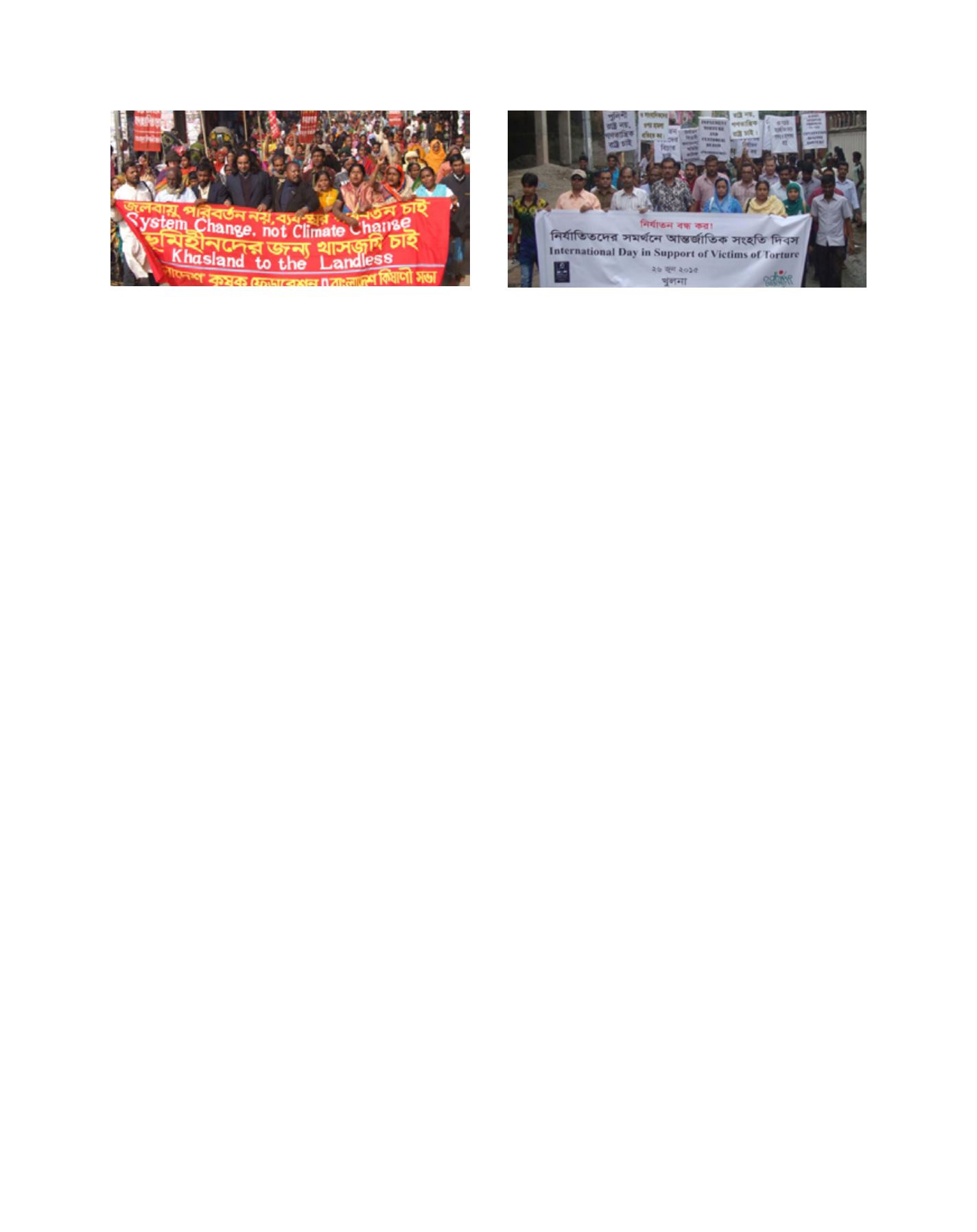
Image: International Journal of Socialist Renewal
Image: ODHIKAR and the Asian Legal Resource Centre