


 12 / 74

[
] 10
A B
et ter
W
or ld
In Tunisia, support to the National Constituent Assembly
and Parliament resulted in a constitutional amendment on
environmental protection (SDG 13). In Colombia, UNDP
supported a draft bill to promote women’s political partici-
pation (SDG 5). In Moldova, UNDP supported a gender audit
of parliament, a parliamentary action plan, and a cross-party
caucus to ensure that women are adequately represented at
the highest levels of government – and other institutions,
at all levels. UNDP’s support to anticorruption – including
through the development and implementation of corruption
risk mitigation methodologies, training programmes, and
methodologies to measure progress in reducing corruption
– helps to address the graft that is a major barrier to progress
in nearly every sector. And in countries like Nepal, and Sierra
Leone, UNDP supported the establishment of community-
driven legal aid networks through which local people can
better understand and claim their rights. These networks
provide legal literacy training, and the practical support
services which vulnerable people need to be able to claim
their rights: transport to police, courts and local government
offices, legal representation, help to fill in forms, make calls,
and navigate complex legal and bureaucratic processes to
obtain their entitlements.
9
The inclusion of SDG 16 in the development agenda has
important consequences. It is no longer only about the kind
of services that are delivered, but also how they are delivered
and for whom so that all people can benefit from sustainable
development and that no one is left behind.
The presence of SDG16 in the 2030 Agenda is thus a
recognition of the importance of good governance and
respect for human rights that were explicitly mentioned
in the Millennium declaration but weren’t translated into a
specific MDG. Since September 2015, promoting inclusive
and peaceful societies, providing access to justice for all and
building effective, accountable and transparent institutions
are recognized as cornerstones of an integrated and univer-
sal approach to achieving sustainable development in all its
facets. The universality of the agenda is also an important
new feature in the theory and practice of sustainable devel-
opment. It means that the goals and targets in the agenda no
longer only apply to developing countries – as was the case
with 7 of the 8 MDGs, while MDG8 fundamentally applied
to the developed nations – but that the entire 2030 agenda,
including SDG 16, matters for all people, including those
living in the most advanced economies.
UNDP has been one of the main convening partners
behind the policy debates that have shaped the 2030 agenda
– and SDG 16 in particular – and is now actively engaged in
promoting broader partnerships to support Member States
and national and local development actors in the implemen-
tation of the SDGs.
For example, UNDP has been one of the driving forces,
within the UN Development Group, behind the “MAPS”
approach to guide implementation of the SDGs.
10
MAPS is
designed to assist countries to “mainstream” the agenda into
national plans for development and subsequently into budget
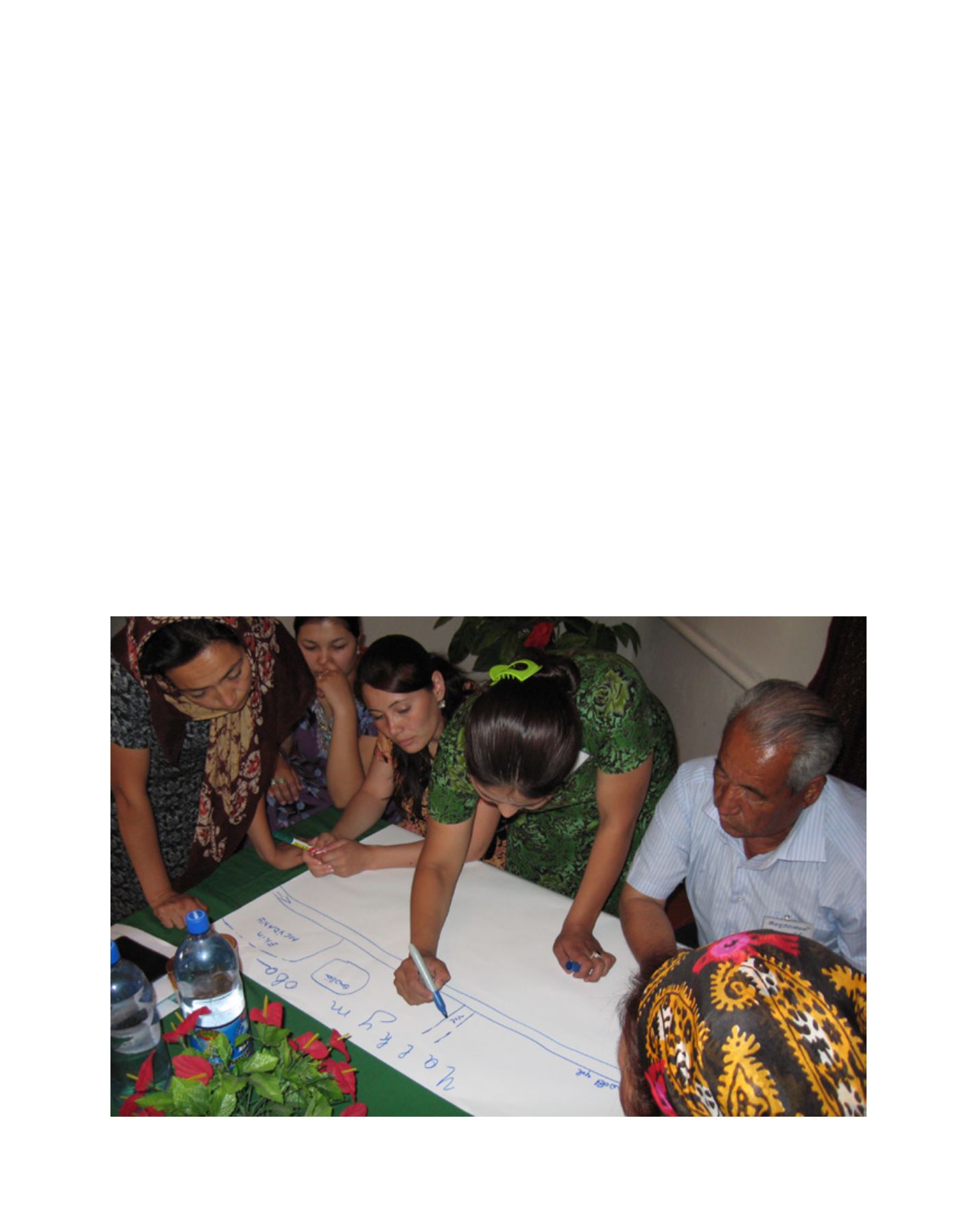
The citizens of Dashoguz met to take important decisions for the development of their province
Image: UNDP