


 17 / 74

[
] 15
J
ust
, P
e aceful
and
I
nclusi v e
S
ocieties
Development assistance for peaceful and
just societies – the need for orientation
Nils Rosemann, Senior Policy Advisor for Conflict and Human Rights, Swiss Agency for
Development and Cooperation (SDC)
1
S
witzerland’s development mandate is threefold and based
on its constitutional objective which states that: “The
Confederation […] shall in particular assist in the alle-
viation of need and poverty in the world and promote respect
for human rights and democracy, the peaceful co-existence
of peoples as well as the conservation of natural resources.”
2
For the period 2017 – 2020 the CHF11 bn Swiss development
budget is committed to combating poverty, discrimination,
exclusion and vulnerability in its partner countries. The
ultimate objective of these efforts is to create better pros-
pects for the future and to reduce inequality. In this regard,
Switzerland contributes to the search for political solutions
to conflicts and promotes respect for human rights.
In order to achieve these long term goals, the Swiss parlia-
ment assigned four out of seven of its strategic development
assistance goals to UN Sustainable Development Goal 16,
namely: “[to] prevent and manage the consequences of crisis
and disaster, and of fragility [and to] promote conflict trans-
formation; [to] support sustainable access to resources and
services for all; development [contributes to] an international
framework for responding to global challenges, [to] strengthen
the rule of law and democratic participation; support institu-
tions serving society and [… to] ensure respect for human
rights and fundamental liberties, and support efforts to
advance their cause.”
3
In order to avoid the pitfalls of offering purely technical
solutions to political problems, a development agency such
as SDC, working either multilaterally or bilaterally, needed
to embark on a mission to become more political, addressing
the root causes of fragility, structural poverty and exclusion.
SDC’s view on peace and development: The fragility lens
SDC’s core mandate rests with the reduction of poverty and
humanitarian needs. Gender equality, good governance and
respect for human rights are essential values, but our experi-
ence shows that: “in achieving the sustainable development
goals, progress in reducing fragility will play a critical role
in the fight against poverty.”
4
SDC’s resolution regarding peace, resilience to withstand
violence and the enjoyment of human rights is that politi-
cal and structural obstacles cannot be removed by technical
proposals but by political means. In 2012 an evaluation of
the performance of SDC instruments in fragile and conflict-
affected contexts in 2012 highlighted that: “There was little
clear evidence of the impact that SDC and other aspects of
Swiss assistance are having on fragility and conflict as a
whole. SDC programmes in fragile contexts tend to be focused
on the symptoms of fragility rather than the root causes.”
5
This misplacced policy focus was diagnosed as being rooted
in a lack of appreciation of change at programme level and
lack of policy guidance at strategic and international levels.
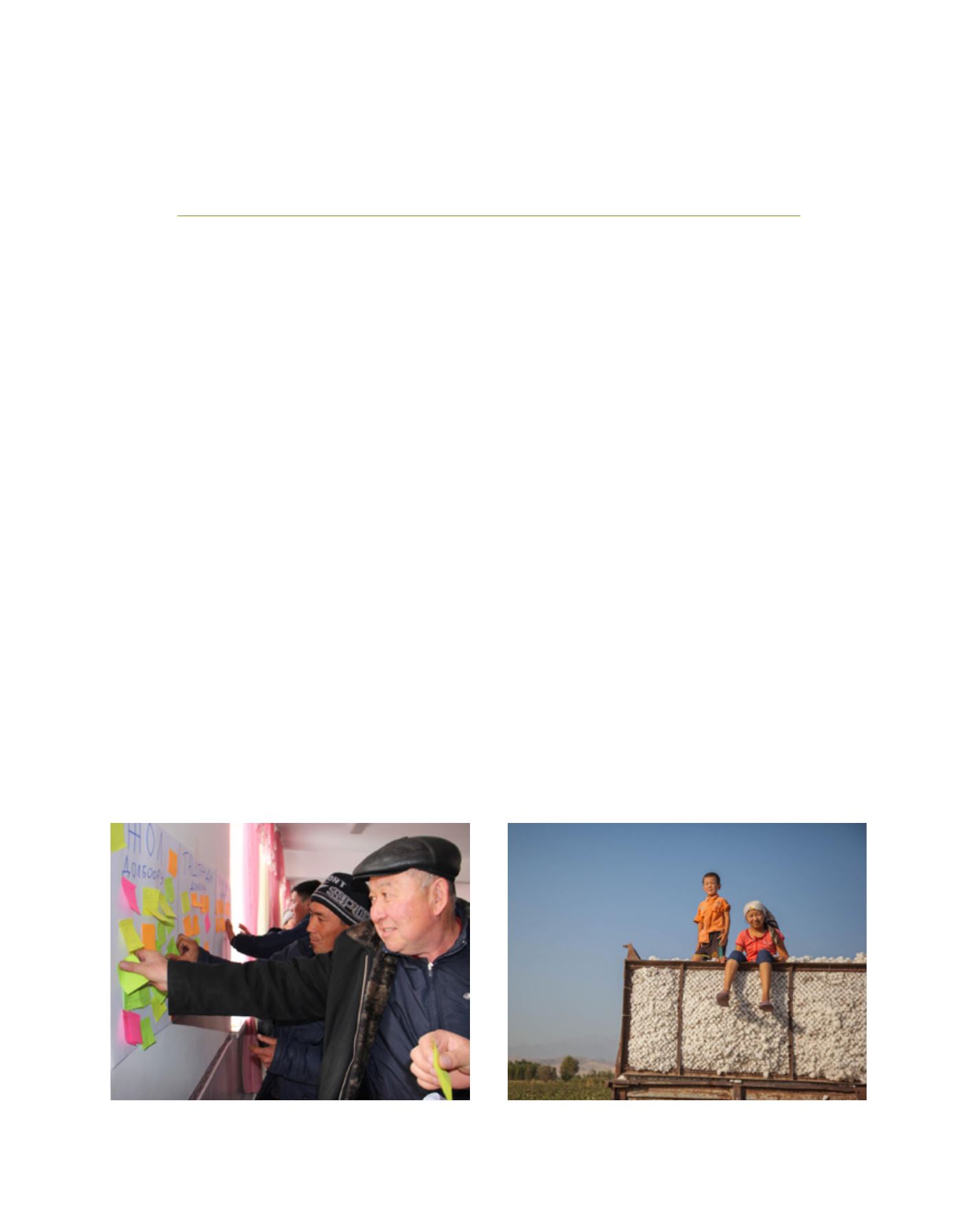
SDC’s support for local governance is contributing to a decentralisation
reform agenda in Kyrgyzstan
Sustainable cotton project in Kyrgyzstan where small holder and family
farmers are prone to child labour and exploitation
Image: © SDC
Image: © SDC