


 16 / 74

[
] 14
A B
et ter
W
or ld
Throughout the project in Ukraine, the Coordination
Center for Legal Aid Provision (CCLAP) has been able to draw
on relevant Canadian technical support and expertise in such
fields as: legal aid system design; administration and oversight;
decentralized service delivery; training; awareness raising;
and, stakeholder engagement. The project is also working
closely with civil society organizations across Ukraine
through a Community Engagement Fund that supports non-
governmental organizations in building partnerships and
linkages among various legal aid service providers to improve
their effectiveness in responding to the legal needs of vulner-
able groups and in addressing barriers to access.
Results
Canadian support and partnerships through these two
initiatives have led to some very real improvements in
marginalized people’s access to justice.
In Mali, awareness and communication activities have
reached thousands of people in several regions of the
country. For example:
• More than 8,000 people have participated in awareness-
raising activities on gender-based violence
• Some 19,000 people have been reached by activities aimed
at disseminating legal information and the availability of
legal services
• Efforts to adopt a law against gender-based violence have
included mobilization of approximately 40 Malian civil
society organizations to support the law.
The participation of victims and civil society organizations
in reconciliation and dialogue has also been an important
component of this work. For example:
• 672 women across the country were trained and accompa-
nied in prevention, conflict management and leadership,
mediation, and advocacy in order to strengthen their
representativeness in the communities;
• Training was provided to 497 community leaders, includ-
ing 170 women and 249 youth, who are core agents of
change in their communities;
• Efforts to achieve social reconciliation and conflict preven-
tion have led to the establishment of eight peace committees,
made up of community leaders and 120 members (30 per
cent of whom are women) who contribute to dialogue and
reconciliation in communities affected by the conflict.
In Ukraine, the new system of legal aid has had consider-
able success since its creation in 2012, and today, the system
features over 540 points of service, deploys over 5,000
lawyers and has over 2,240 employees.
In terms of legal aid provision in criminal proceedings and
for detained, arrested or imprisoned individuals, the system
has:
• Recorded over 76,480 cases of legal aid provision to
detained criminal suspects
• Recorded 41,803 cases of legal aid provision to those
under administrative detention or arrest
• Managed over 191,594 defence cases.
Since the system began offering legal aid support for civil and
administrative proceedings it has:
• Processed over 409,420 applications
• Provided consultation services to 348,413 individuals
• Represented over 54,714 clients in court proceedings
• Referred another 13,124 to partner institutions and organ-
izations for assistance.
Of the broad spectrum of clients seeking support in civil
and administrative cases, the large majority, 57.4 per cent,
are women.
One major success, based on estimates from local human
rights organizations, is that in 2013, early access to legal aid
was guaranteed to all detained persons within two hours
following detention and prior to the first interrogation by
police. As a result, since then, the number of human rights
violations of detainees committed by police has decreased by
at least 50 per cent.
Lessons learned
Canadian efforts in Mali and Ukraine have helped us learn
some key lessons. In Mali, the role of local partners has been
essential to increase the scope of the project and adapt to
the insecure environment, which remains a key challenge
despite the 2015 peace accord.
In Ukraine, we have seen the importance of embedding
legal aid within a broader community context to be success-
ful and sustainable. There is a growing recognition of the
need for a new curriculum in law schools and professional
development within the legal profession to reflect the new
legal aid regime. Efforts are also underway to develop train-
ing for police officers on what the new legal aid system means
for them and for Ukraine’s most marginalized citizens.
Canadian efforts to improve access to justice in Mali and
Ukraine, and many other countries around the world, are
helping to strengthen the work of governments and civil
society organizations, and build the capacity of women to
represent their communities and collectively address the
challenges they face. These efforts are also contributing to
the achievement of SDG 16 in these countries. For more
information on these and other international assistance
projects funded by Canada, please consult the Government
of Canada’s Project Browser.
1
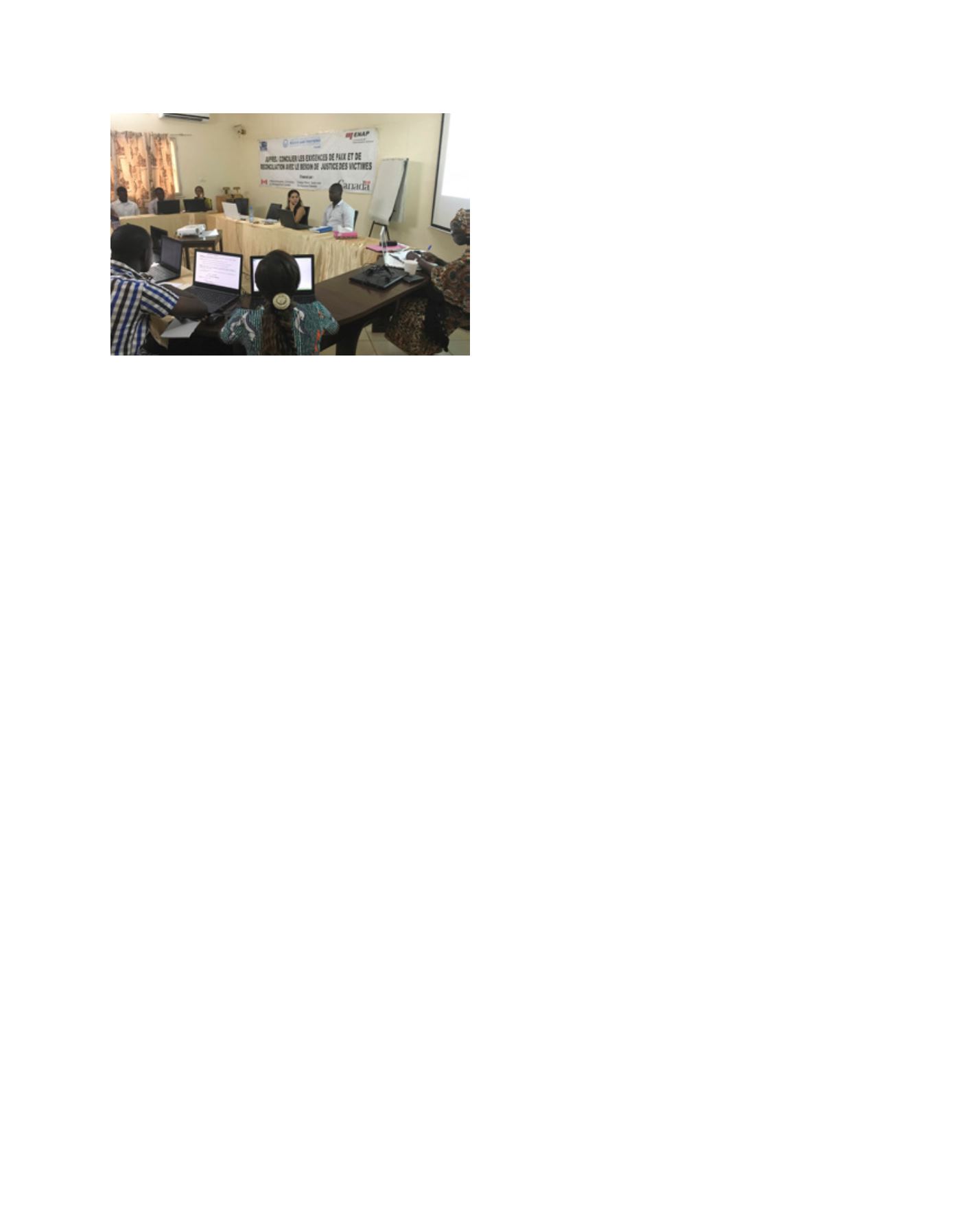
Judicial training for young Malian jurists
Image: Coordination Centre for Legal Aid Provision (CCLAP)