


 20 / 74

[
] 18
A B
et ter
W
or ld
The Baku Process – sharing cultures
for shared security
Abulfas Garayev, Chair of the WFID National Organizing Committee, Minister of Culture and Tourism of the
Republic of Azerbaijan; Mike Hardy, Professor and Executive Director, Centre for Trust Peace and Social Relations,
Coventry University, Member of the Baku Process International Task Force; Vasif Eyvazzade, Head of the
International Cooperation Department , Ministry of Culture and Tourism of the Republic of Azerbaijan, Secretary
of the Baku Process International Task Force
A
zerbaijan sits at the crossroads of global cultures and
civilisations, with a history, culture and economy
that over the centuries have helped form a tradi-
tion of respect for different cultures and nationalities and
a rejection of intolerance to the ‘other’. Azerbaijan society
embodies the Eurasian idea of intercultural and interreli-
gious dialogue, an harmonic approach to identity through
embracing diversity.
The Country took a major step in 2008 when President
Aliyev initiated the
Baku Process
for the promotion of inter-
cultural dialogue. The
Baku Process
comprises an open and
respectful exchange of views between individuals and groups
with different ethnic, cultural, religious and linguistic back-
grounds and heritage, living on different continents, on
the basis of mutual understanding and respect. The
Baku
Process
thrives through partnership and through conven-
ing influential and powerful dialogue between leaders from
international organisations, national governments, civil
society and the private sector.
The World Forums on Intercultural Dialogue (WFID), held
biannually in Baku, are an important and continuing part of
the Baku Process, and the fourth World Forum, 04–06 May
2017 with the theme of “Advancing Intercultural Dialogue:
New avenues for human security, peace and sustainable
development”
1
, further consolidates this international plat-
form. WFID enables and encourages people, countries and
organizations around the globe to take concrete actions to
support diversity, dialogue and mutual understanding among
nations by raising awareness on the importance of intercul-
tural dialogue worldwide.
The Baku Process helps place intercultural dialogue and
cultural diversity higher on the international agenda as a
critical element for achieving human security and as a prime
responsibility of our time. WFIDs organised to date have
brought together heads of governments, ministers, heads of
various international organisations, senior policy makers,
cultural professionals, goodwill ambassadors, experts, jour-
nalists, practitioners, prominent intellectuals and activists.
Following the development of the Sustainable Development
Goals, discussion at WFID 2017 will place side by side inter-
cultural dialogue, human security, peace and sustainable
economic development, highlighting the interdependence of
these and, importantly, the centrality of dialogue for peace-
ful relations and sustainable development, and hence human
security.
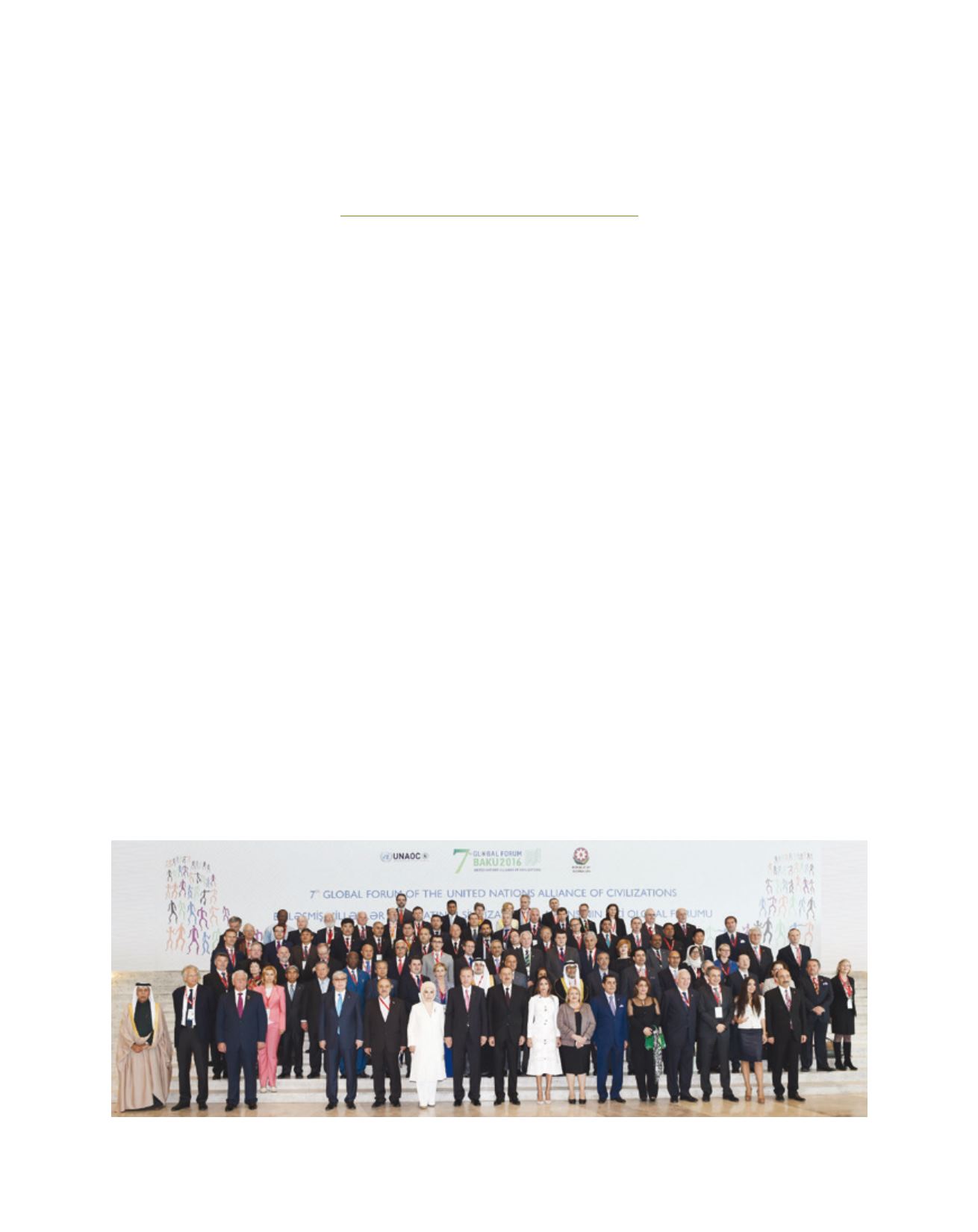
UNAOC 7th Global Forum, 25–27 April 2016, Baku, Azerbaijan
Image: MCT, Azerbaijan