


 15 / 74

[
] 13
J
ust
, P
e aceful
and
I
nclusi v e
S
ocieties
rule of law at the national and international levels and ensure
equal access to justice for all
. Canada was a strong supporter
of including access to justice and rule of law in the SDGs,
and we are actively engaged in helping to achieve this target
at home and abroad.
Canada has a unique judicial experience to share with the
world, rooted in diverse traditions. Our dual legal system
with common law used throughout the country, a civil law
tradition in Quebec, and Aboriginal law all inform our inter-
national assistance for judicial reform. Canada not only has a
keen understanding of both common and civil law systems,
but a nuanced appreciation for the challenges in both. We
are also aware of the advantages to creating a justice system
uniquely responsive to the historical and linguistic needs of
a diverse and pluralistic population.
Project examples
Canada is building on this experience to help improve the
rule of law and access to justice in many countries around
the world. We undertake context-specific approaches, with
the effect that improving people’s access to justice can look
very different from one country to the next, even in the same
region. This case study highlights two very different, but
equally important examples of Canada’s efforts to improve
marginalized people’s access to justice in Mali and Ukraine.
Despite divergent local circumstances and very different
project objectives, these two initiatives demonstrate the
value of partnerships at all levels and the indispensable role
of civil society in helping to promote greater access to justice
in their societies.
In Mali, Canada is supporting a consortium of partners
including Lawyers without Borders Canada, the Center for
International Studies and Cooperation, and the National
School of Public Administration of Quebec to help foster justice,
conflict prevention, and reconciliation. These efforts are in
direct response to the causes and consequences of the crisis
which has shaken Mali since January 2012. In this particular
context, improving access to justice requires a multidimen-
sional response to a complex situation that combines justice,
social dialogue, and efforts to promote human rights. The focus
of this work is targeting people directly affected by the crisis,
particularly, women and children, with a view to ensuring that
their rights are fully respected within broader efforts to restore
peace and stability in Mali.
In particular, the Canadian partners are supporting Malian
civil society organizations to raise awareness about gender
based violence, provide legal services, foster a social dialogue
among Malians on ways to collectively prevent and resolve
local conflicts, and select appropriate community transi-
tional justice mechanisms that are sensitive to the victims
of the conflict.
In Ukraine, efforts to improve people’s access to justice
have led to the creation of a new system of legal aid, which
focuses on the needs of marginalized Ukrainians, including
but not limited to persons with low-income, persons with
disabilities, orphaned children, and internally displaced
persons. Prior to the passing of the law on Free Legal Aid in
June 2011 all Ukrainian citizens were obliged to pay privately
for legal advice and representation, which often rendered it
out of reach for the most marginalized. Canada is supporting
the Canadian Bureau for International Education to work
closely with the Government of Ukraine and Ukrainian civil
society organizations to help in the progressive launch of this
new legal aid system. The Ukrainian government’s long-term
strategic agenda includes development of the legal aid system
as a priority, as does the Judicial Reform Strategy and the
Human Rights Protection Strategy, demonstrating the politi-
cal will to make legal aid available to vulnerable Ukrainians.
The first phase of the roll out of this new system began in
2012 with the establishment of the Coordination Center for
Legal Aid Provision (CCLAP), an arms-length agency of the
Ministry of Justice of Ukraine. CCLAP’s mandate is to improve
social justice and the rule of law in Ukraine by making equitable
access to quality legal aid services for all Ukrainians, in particu-
lar individuals frommarginalized groups, a reality. Subsequent
phases focused on the provision of free legal representation in
criminal cases, extending the right to free legal representation
in civil (family) and administrative cases, and extending access
to legal aid to the grassroots level. These activities aimed to offer
a mix of legal information and consultation, as well as legal
representation before the courts.
Partnerships
One of the key underlying factors for success in each of
these initiatives has been the partnerships with governments
and civil society – in the capitals, but also in smaller, more
remote communities.
In Mali, a partnership approach has permitted a wide range
of activities to be carried out in several regions of the country,
including the northern regions, which are highly insecure.
The Canadian consortium of partners has partnered with
nearly 20 Malian civil society organizations from across the
country. These organizations have solid expertise and knowl-
edge of the local context that are essential for the promotion
and defence of human rights in the more insecure regions.
In particular, these partnerships have enabled efforts to be
undertaken in some regions earlier than expected. A reflec-
tion and analysis of the partnerships developed with these
organizations is currently under way to better understand
their needs and to further strengthen their capacity, building
on the lessons and experiences to date.
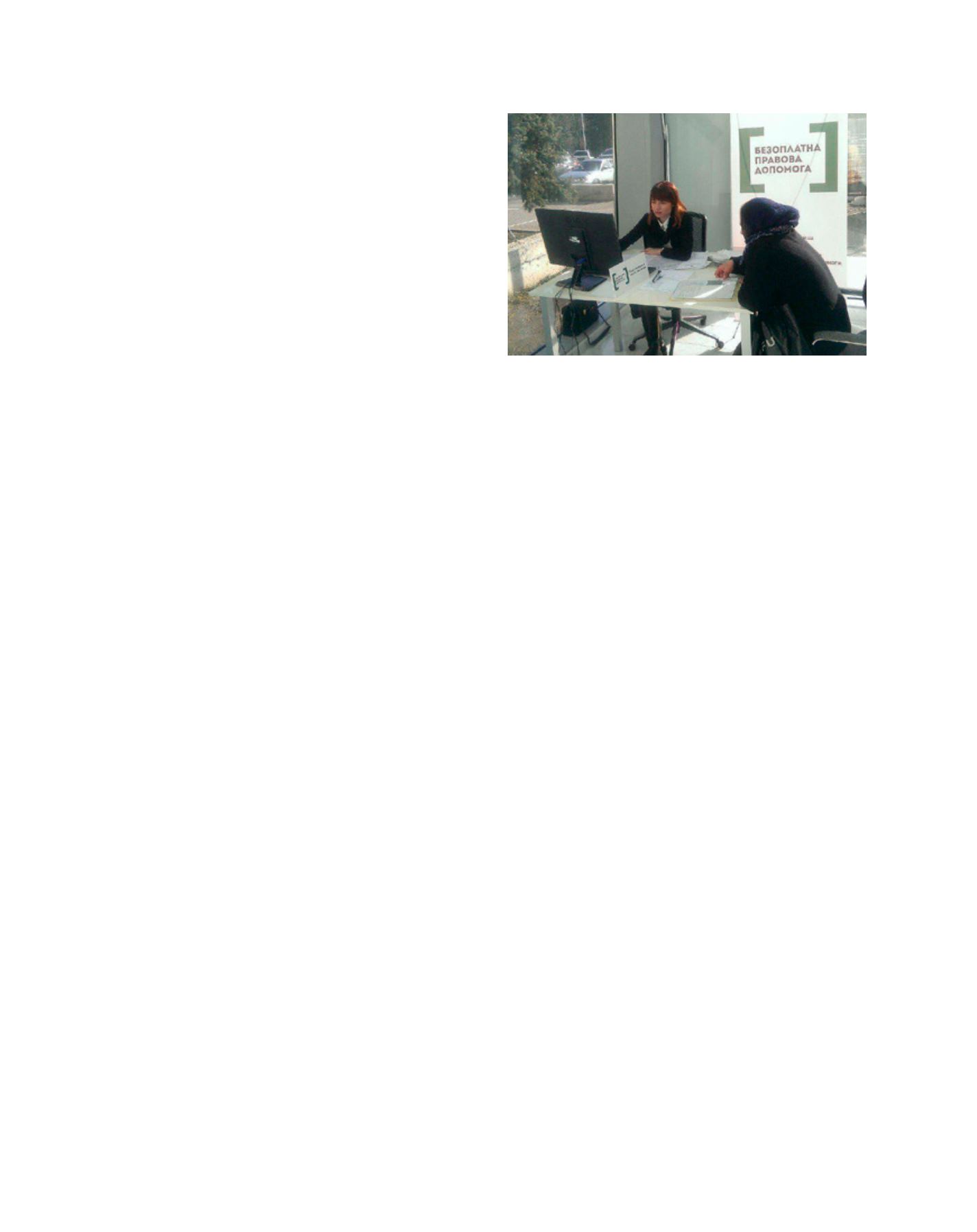
Image: Coordination Centre for Legal Aid Provision (CCLAP)
Provision of legal aid at the Odesa office