


 19 / 74

[
] 17
J
ust
, P
e aceful
and
I
nclusi v e
S
ocieties
oped through the forum of the International Dialogue and
signed by more than 40 countries, including Switzerland,
and organizations at the fourth High Level Forum on Aid
Effectiveness on November 30th 2011 at Busan, Korea.
Knowing the shortcomings of any policy agreement, that
is to implement it successfully on a national, but preferably
local level, Switzerland has sought to anchor this “Aid4Peace”
perspective internationally by taking over responsibility as
Co-Chair – together with UNDP – of the DAC International
Network on Conflict and Fragility (INCAF). INCAF’s focus
is on delivering the SDGs in states affected by fragility and
conflict, using the lens of the New Deal for engagement in
fragile states. A major achievement in this regard was the
2016 Stockholm Declaration
11
as a way of ensuring that no
one is left behind in preventing and addressing the root
causes of conflict and fragility.
Furthermore, Switzerland supports the inclusion of
the stakeholder structure, ensuring cooperation between
affected countries, donor countries and civil society, in Goal
16 implementation. In this regard Switzerland engages with
the Pathfinder Initiative for Peaceful, Just and Inclusive
Societies,
12
aiming to foster an integrated approach in order
to strengthen Goal 16’s universality, focus on inequalities,
apply a gender and human rights based approach, include
regional and global dimensions of peace and ensure collabo-
ration between all relevant actors and sectors.
In, around or on fragility: more explicit theories of change
and better monitoring
As explained above, SDC’s operational experience in fragile
and conflict affected contexts showed that development and
humanitarian assistance will be sustainable only if the root
causes of conflict are addressed, structural issues of violence,
exclusion and discrimination are tackled and a culture of
human rights is promoted. However, Switzerland, as a small
bilateral donor agency, is not always able to solve problems
of fragility and human rights and thus finds itself working
around these issues rather than focusing on the central prob-
lems. Risks are higher in these contexts requiring quick wins
and tangible results especially to satisfy public opinion.
In order to maintain a long term perspective, Switzerland
introduced a fragility-focused mindset for its results-based
management in 2013, with additional mandatory reference
indicators in 2017. The reference indicator systemwill help SDC
to coherently report on results as well as to steer programmes
and enhance their contribution to fragility reduction.
The case of governance in the security and justice sectors:
the case for rule of law
SDC’s focus on governance, especially within the justice
and security sector might illustrate how to better work
on the reduction of fragility. Accountability of public and
private security forces, mutual respect of the law and access
to justice are preconditions of a fair, predictable and just
system, free from corruption and arbitration. Conflicts and
fragility, violence and destruction, are based on factual as
well as perceived injustices. Enabling development must
focus on freedom from fear. Governance, access to justice
and rule of law programmes – which are at the core of Goal
16 – must therefore be people-oriented and focus on “good
enough” rather than perfect systems.
13
SDC is substantially engaged in the justice sector and
spends approximately CHF35m per year on projects and
programmes that deal either exclusively or partly with justice
sector reform. But international criticism of rule of law and
justice sector programming
14
is significant such that these
interventions must recognise the deeply political process in
which they engage; that a sole focus on form instead of func-
tion and the replication and import of models and laws does
not meet local realities and needs; and that the realities of the
political economy and structural poverty must be addressed.
Thus, rule of law and access to justice become synonymous
with reduction of fragility and reestablishing trust among
communities, people and institutions. Internal assessments
showed that SDC is not immune to quick-win, solution driven
and top down approaches. In order to reorient its justice and
rule of law portfolio, SDC has strengthened its analytical
tools, recognized the politicised nature of these programmes
and will systematically take legal pluralism into account.
In other words, SDC realigns its programmes by taking the
context as a starting point and putting instances of perceived
or actual injustices at the corner of its interventions.
Again, the above mentioned system of reference indicators in
relation to the support of governmental functions, the strength-
ening of independence and oversight and the protection of
rights and perception of legal services, will help SDC to improve
theories of change with better monitoring and reporting.
Conclusions
Goal 16 objectives in fostering peaceful, just and inclusive soci-
eties are, for SDC, both a precondition and a result of fulfilling
its mandate of poverty reduction and humanitarian assistance.
There is no sustainability without a focus on context-rooted
power relations, causes and effects of exclusion, discrimina-
tion and reoccurring human rights violations. In order to end
poverty we have to end ignorance of economic, social and
political realities that impede development, inclusion and
peace. “Fragility” is one description of these obstacles, as “just
and peaceful societies” is another phrase for a set of solutions.
But what matters is not the wording, but a tangible change for
people. The discussion around goal 16 already provides a plat-
form for discussion. In 2030, Goal 16 will be the litmus test for
the success of the Sustainable Development Agenda. Emerging
conditions for peace will enable sustainable development only
if our contribution and shared responsibility can address the
root causes of violent conflict and war.
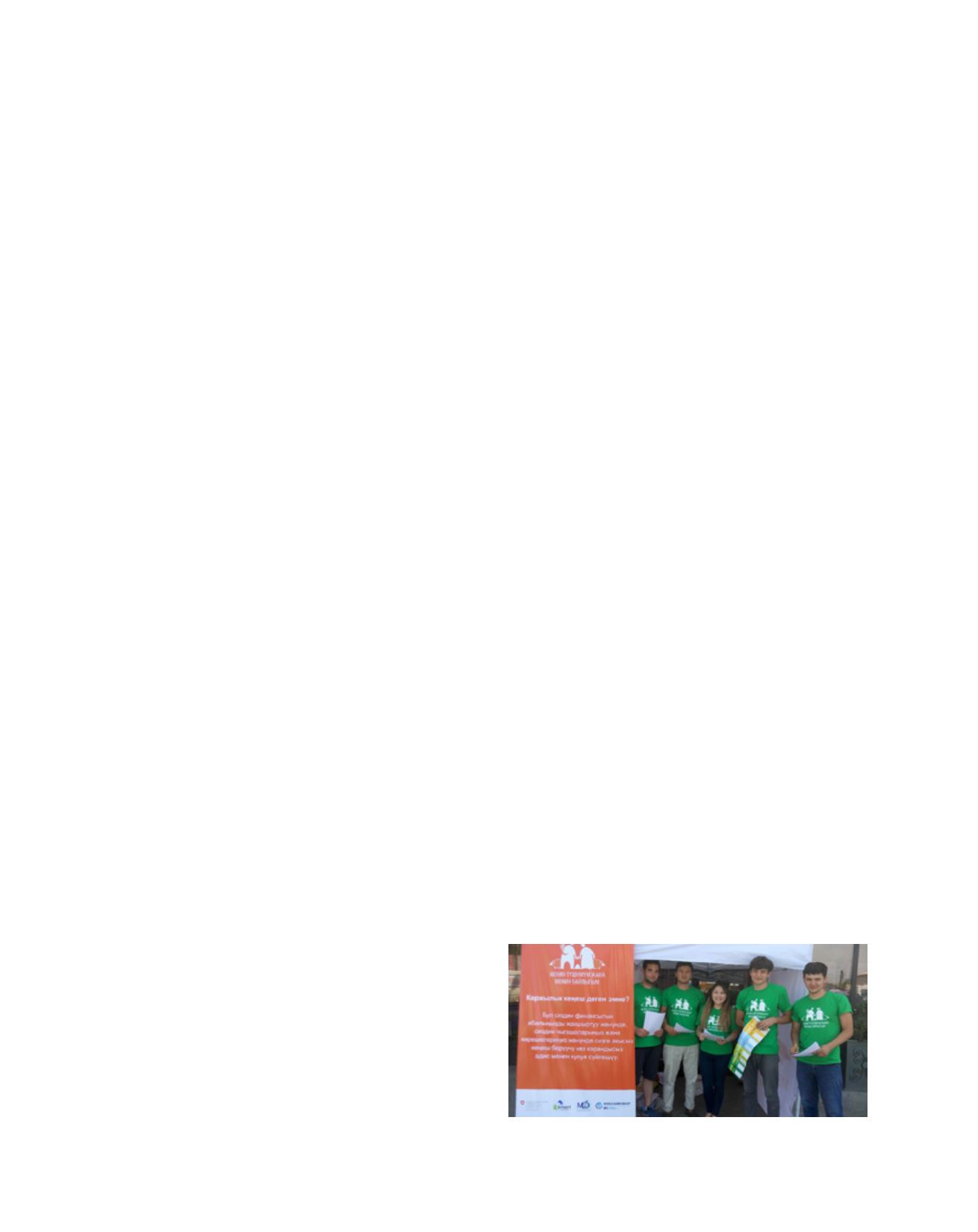
IFC and Swiss microfinance project in Kyrgyzstan
Image: © SDC