


 18 / 74

[
] 16
A B
et ter
W
or ld
The policy gap was filled in 2015 with SDC’s peacebuilding
and statebuilding strategy, taking at its core the idea that:
“the concept of fragility thus encompasses missing or insuf-
ficient statebuilding and peacebuilding efforts on national as
well as local levels. If these are not integrated as an overall
objective into development and humanitarian efforts of SDC,
poverty cannot be sustainably reduced.”
6
SDC therefore departed from the somewhat state-centred
OECD model of fragility given at that time and, instead,
included in its approaches: governance and community
related resiliencies to withstand all forms of violence, the
support of conflict transformation, and respect for human
rights and rule of law. In order to communicate this concept
to its decentralized operations, SDC used the OECD Ten
Principles for Engagement in Fragile States
7
and its main
objective to “take the context as a starting point”. This
prepared SDC to be better positioned to complement its
technical skills with political understanding, bringing
programmes from different branches together in order
to address the root causes of conflict and fragility, and to
increase flexibility so that it could respond to opportunities
or risks more quickly.
Adopting a long term perspective in fragile and conflict
affected contexts made it possible for SDC to commit – in
addition to its humanitarian spending – an increase from 44
per cent of bilateral development spending in 2016 toward
the target of 50 per cent by the end of 2020.
Fit for purpose with comprehensive risk management
Switzerland’s commitment to work in fragile, conflict
affected and hostile environments is based on its own expe-
rience and mandate as well as on international consensus.
Countries affected by conflict and fragility were among those
left furthest behind by the Millennium Development Agenda.
By 2030, poverty will become increasingly concentrated in
fragile states and the OECD predicts, even under the best
case scenario, that more than 60 per cent of the global poor
will be located in these contexts.
8
While reducing fragility
and conflict causes are the largest opportunity for reducing
structural poverty and exposure to humanitarian needs,
there are associated risks. “International engagement in
fragile and conflict-affected states […] poses considerable
risks for donors and implementing partners, who must
contend with high levels of insecurity, political instability,
weak institutions, and the failure of basic state functions
that typically characterize such states […] outcomes are hard
to foresee and control, and the possibility of returning to
violent conflict is always present.”
9
For SDC, comprehensive risk management demands
becoming fit for purpose and staying engaged even where
other donors have given up field work and shifted from
development to humanitarian or even military assistance.
Cases such as SDC’s engagement in Nepal, Mali and Burundi
showed that comprehensive risk management – developed
on the basis of OECD’s Copenhagen Principles
10
– helped
best in addressing context, programme and institutional
risk. For SDC this is part of context specific and conflict
sensitive management such that, instead of developing new
instruments, we prioritised conflict sensitivity, human rights
based approaches and good governance principles as well as
a gender perspective on operational instruments for project
management, strategic planning and reporting.
If peace, conflict issues, human rights and rule of law
become commonplace, the impact on societies and systems
of governance is not great. The challenge is to balance the
contextualized theories of impact with coherent program-
ming and reporting. In doing so, SDC has developed a range of
operation-based reference indicators, helping to frame techni-
cal programmes – such as water, food security or employment
– as its contribution towards the reduction of fragility.
Agenda 2030 Goal 16: Aid4Peace or a mix between
Millennium Goals and New Deal on Peace Building
Goal 16 reflects much of why Switzerland actively promotes
and participates in the New Deal for Engagement in fragile
states and the International Dialogue on Peacebuilding and
State building. For Switzerland, the New Deal filled the
gap left open by the Millenium Development Goals and the
Millenium Declaration. It is the key agreement between
fragile and conflict-affected states, development partners, and
civil society to improve the current development policy and
practice in fragile and conflict-affected states. It was devel-
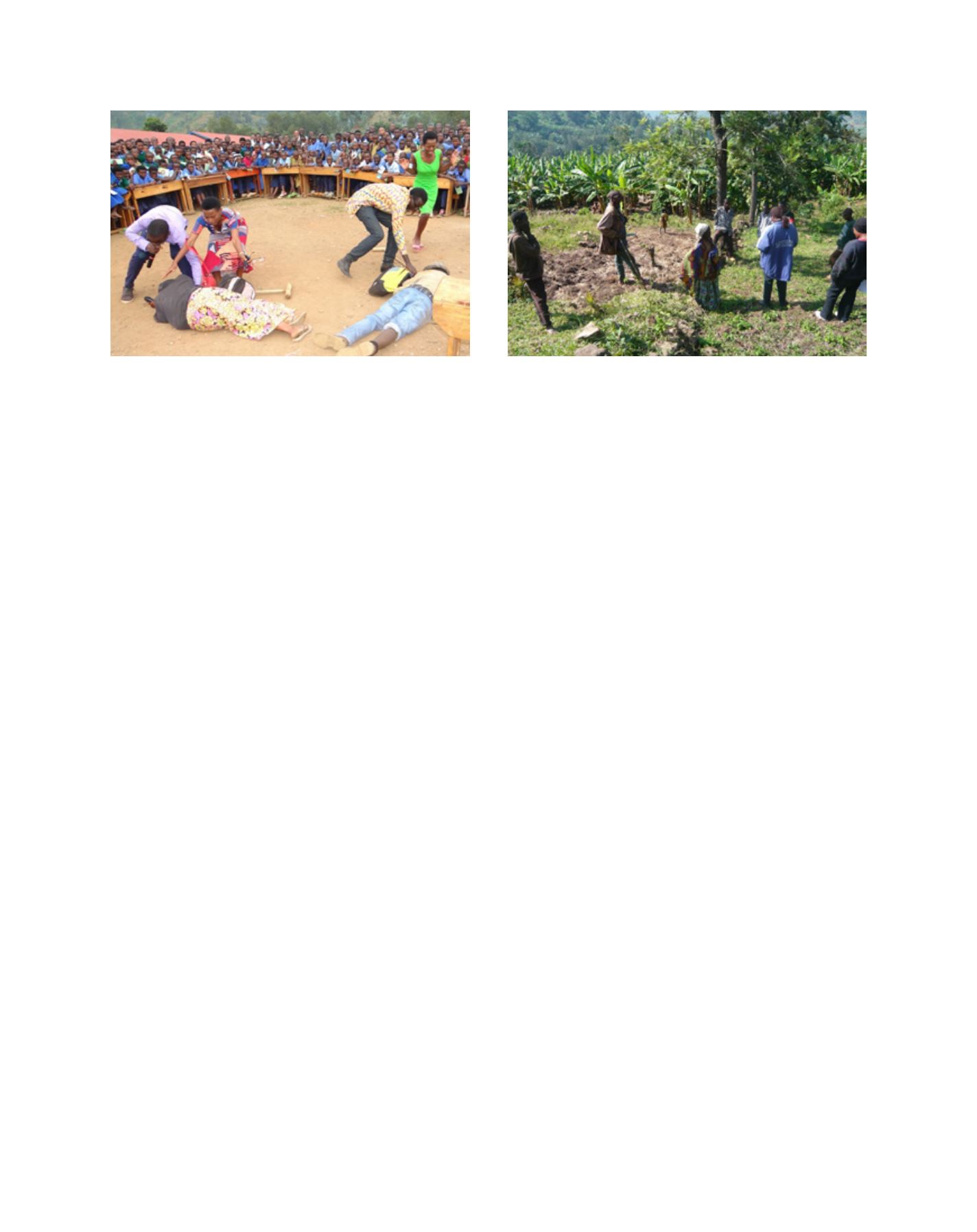
Provision of psychosocial care for the women and men affected by sexual and
psychological violence in Burundi
Land rights and titles are a main source of conflict and violence in Burundi.
SDC supports a system of acknowledgment and certification of land use
Image: © SDC
Image: © SDC