


 14 / 74

[
] 12
A B
et ter
W
or ld
Canada’s international assistance contributes
to increasing access to justice –
efforts in Mali and Ukraine
Meghan Watkinson, Deputy Director, Governance, Global Affairs Canada and Co-Chair of the OECD-DAC
Network on Governance
R
espect for the rule of law and access to justice are
essential to achieving peace and security, poverty
reduction and longer term sustainable development.
They also influence the capacity of countries to attract and
host foreign investment, create a predictable base for domestic
business growth, lower environmental and political risk, and
help provide people with the power to exercise their rights.
In their 2013 working paper,
2015 and beyond: the govern-
ance solution for development
, Transparency International
demonstrates that in countries that are more open, accounta-
ble, and respectful of the rule of law, there is better education,
health, and access to clean water and sanitation.
Yet sadly, around the world approximately four billion
people do not have access to justice. Many of these people
are the poorest and most marginalized in their communi-
ties, including people with disabilities, indigenous people,
LGBTQ2 persons, and women. When the rule of law is not
effective and predictable, people and their livelihoods are
vulnerable to insecurity, to abuses of power, and to viola-
tions of human rights, which threaten their well-being and
hinder their social and economic opportunities to improve
their lives. This lack of access to justice often means that the
poorest and most marginalized are unable to seek redress
and compensation and are therefore disproportionately
impacted by human rights violations, corruption, and other
injustices in their communities.
The
World Development Report 2017 on Governance and the
Law
acknowledges that although laws may exist in many
countries that could address these injustices, in practise
they are often not implemented. This is particularly the
case for injustices against women. Despite progress that has
expanded the scope of women’s legal entitlements around
the world, for most of the world’s women these laws do not
always translate into equality and justice. Gender based
violence persists in many regions, particularly in situations
of conflict and fragility, and is a major barrier to women’s
equality, and efforts for justice and peace in these societies.
The international community has recognized the impor-
tance of the rule of law and access to justice for sustainable
development in target 3 of SDG 16 which
aims to promote the
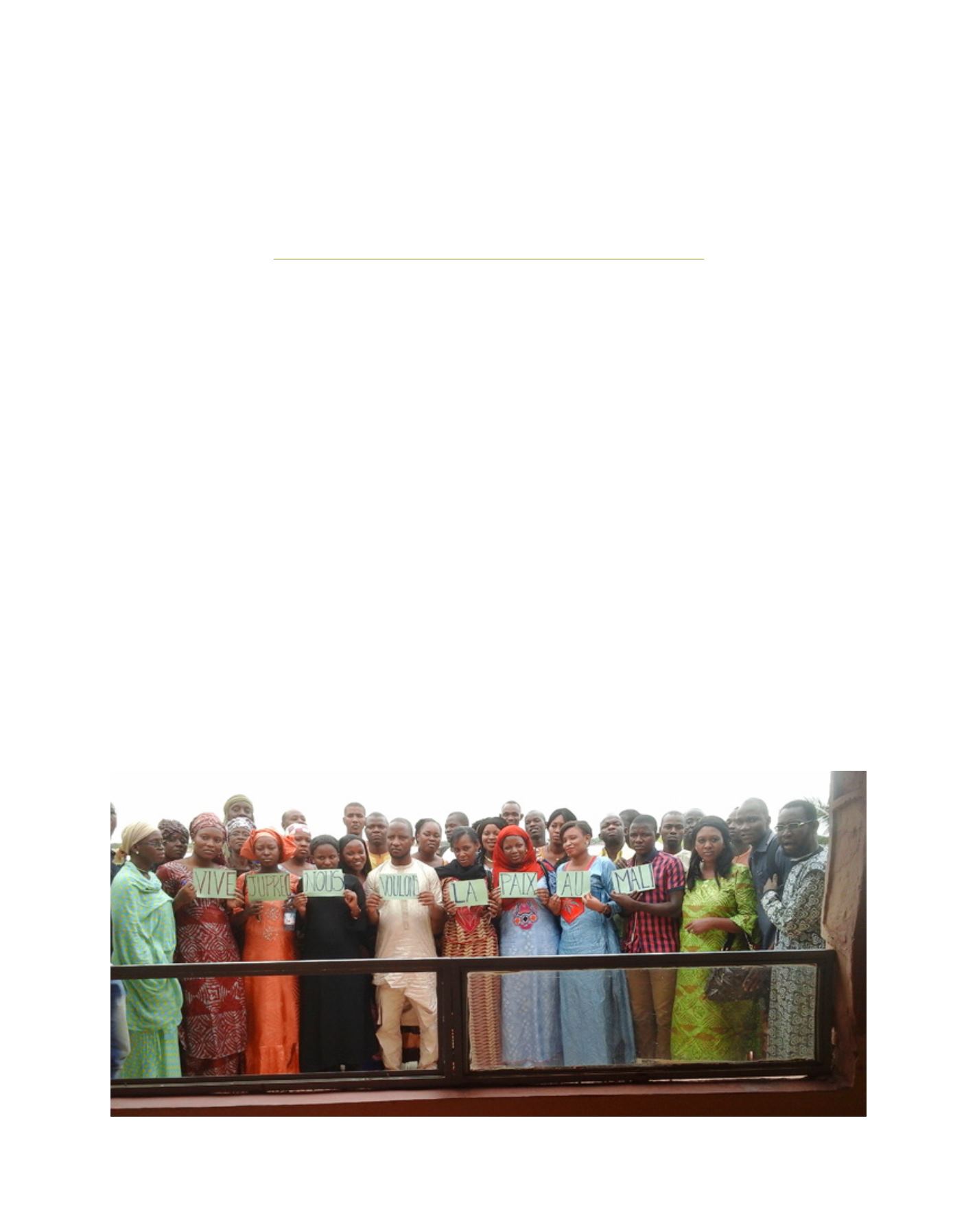
Long live JUPREC (the project), we want peace in Mali:
field partners and members of the project team in Mali
Image: Lawyers Without Borders Canada